When I launched this site a decade ago (!), I expected to share a few posts about the exhausting, cathartic, sometimes funny and strangely exhilarating process of cleaning out my parents’ attic. One damp box of mid-20th century toothpicks led to another, and thanks to support and input from readers like you, I learned that sharing family stories not only kept my late parents alive, it sustained me through the joys and sorrows of the years that followed.
In that spirit, and because honestly, how much more can be said about faded photographs and mildewed button boxes, I’ve decided to creak shut the attic door and launch a new site. It’s called “Why the World Wags,” and in it, I plan to wax on about well, whatever grabs me as I move along through life. Ten years on (!!!) from that first post here in “My Mothers’ Attic,” I find myself teetering at the edge of what some call the golden years. Has there ever been a more obvious euphemism? Golden in the sense of being burnished by life perhaps, but there are days when the world around me seems cast in the gray light of dusk. And yet! At other times, that world seems to sparkle in a way I rarely noticed when I was younger–when a bluebird lights on a leafy branch in our back garden, his feathers aglow with morning light, or when I’m able to revisit a place I’ve come to love, like the brilliant waters off the coast of Belize pictured above, or when my toddler granddaughter reaches for me, smiling, and calls my name (which at her bidding, seems to be “Gaga”).
Golden moments, every one.
If you’d like to join me on my continued journey, here is the first newsletter/post from the new site. I’ll be migrating some of my more popular posts from here to there, usually with some editing, but I’ll leave the Attic open a good while, too. To visit the new site itself, just click below. If you like what you read, consider subscribing (s’il vous plaît!)!
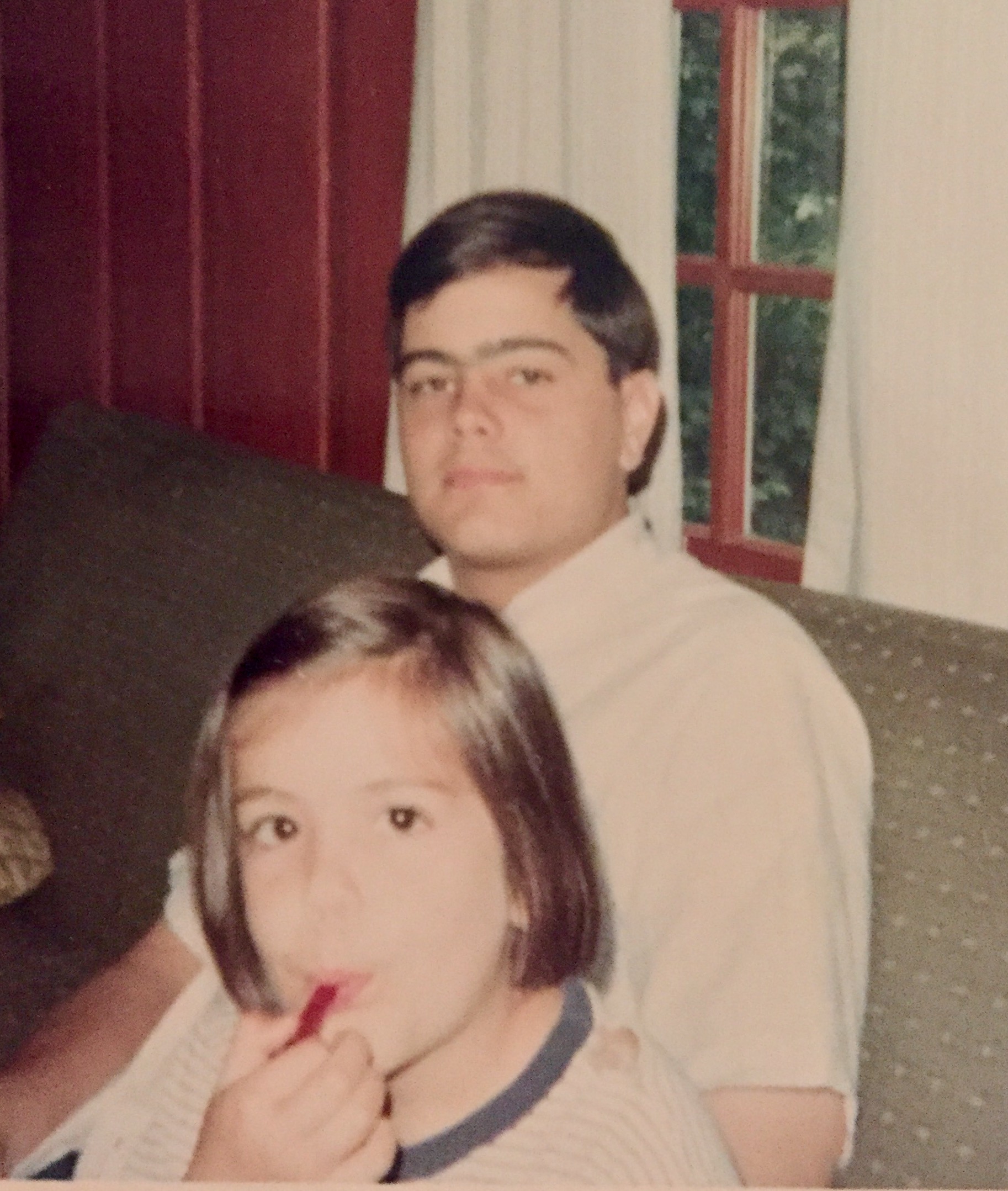
Dreamy pre-teen moi. Photo courtesy of my mother’s attic 🙂
Is wist a word? The OED says not, but I would argue for its inclusion. As an early teen, I was the walking definition of wistful, meaning, quite literally full ofwist. Let’s consider possible synonyms … Was I instead melancholy? Nope, the feeling was less gut-gripping than that, yet stronger than longing. Reflective? No way. That suggests an intellectual hankering, which believe me, was years away. But I leaned hard into the wistful in those unsettled days. I was absolutely captive to if not wist, then wistful-ness? So clunky, that word. Plus the emphasis is wrong, less the wist, more the ness.
Shall we delve into a few of my favorite musical selections of the era? There was Carole King’s “Too Late Baby,” and Jimmy Buffet’s “Havana Daydreaming,” and for sure James Taylor’s “Fire and Rain.” Wist, wist, wist … And let’s not forget “Smoke Gets in Your Eyes,” a remake by the Platters that was an oldie even in my day. I adored it ne’ertheless. I distinctly remember, after a date that went poorly, meandering up my darkened hallway to my father’s study to spin it on the family turntable. Certain I would never date again, I slumped to the window and stared out at our front lawn, moonlight in the weeds. I may have actually shed a tear, so wrapped up was I in my manufactured teenaged angst.
Yet these numbers pale one and all beside the song that gave perfect voice to what was bottled up inside me, a little ballad by the soon-to-be forgotten group, Looking Glass—
Brandy, you’re a fine girl, what a good wife you would be, but my life, my lover, my lady, is the sea …
Is it regret I hear in these lines? Does regret equal wist? No, not really. At least regret is not precisely what “Brandy” evoked for me. It certainly wasn’t sorrow—what did I know of sorrow at age fourteen? But each time my radio played that quick guitar twang, then the riff on the keys followed by “doo doo ‘n doo doo,” my belly quivered and my heart swelled. I would crank up the volume and sing along with great gusto. And no verse bewitched me more than the last: At night, when the bars close down, Brandy walks through a silent town, and loves a man who’s not around …
Oh, the heartache! The delicious pain! This woman, this lovely barmaid, strong and independent yet imprisoned by love for a sailor she could never have. Even now I can feel it, the … the … the wist, for heaven’s sake! One refrain and I’m a skinny girl with long stringy hair who longed for curves ample enough to attract the one swaggering boy everyone yearned to make out with. Yep, there I stand in the dark corners of a fellow middle schooler’s smoky rec room while my friends, maybe a few enemies, roll around on the couch or slow-dance to “Stairway to Heaven.” I lean against the wall, less flower than sprout, and shut my eyes so that I might better conjure, and draw strength from, my precious Brandy—footsore, coins in the pocket of her apron—as she lays that whiskey down. Looped around her neck of course is a braided chain made of finest silver from the north of Spain. And it bears the name of the man Brandy loves! A man (her sailor!) who brought gifts from far away but made it clear he couldn’t stay.
How silly I was, a silly girl looking for love in all the wrong places. Unless maybe, just maybe, what I really hungered for wasn’t puppy love, or even romance. Maybe I couldn’t get enough of “Brandy” because of its poetry–a stretch, sure, but with apologies to any real poets out there, bear with me. Pop tune it may be, but the lyrics and the melody blend perfectly to create a certain mood (right?). A mood, I believe, that reflects and heightens the emotion its songwriters sought to convey. At the very least there’s this: Perhaps in those confounding years of my youth, I longed–without realizing it, mind you–for a sort of experience that was as yet out of my reach. As she pulled beers and served those sailors as they talked about their homes, Brandy took me with her, to that faraway fishing village by the sea where a spunky young woman could make it on her own (albeit without love). The lyrics, the harmonies that bolster them, rustled up in me not only the wobbly ache of the teenaged crush, but the exhilaration of finding oneself in an unfamiliar place or situation, the joy touched with loneliness that solitary travel, for example, can trigger, and that several years on, I would come to know myself, and to treasure.
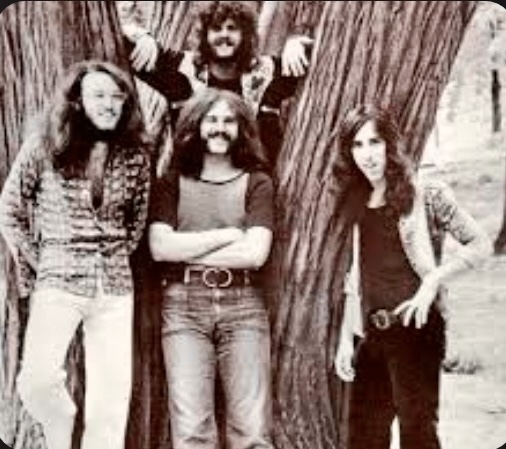
Looking Glass, the rockers whose one-hit wonder tattooed my teenaged heart.
So maybe my pre-pubescent self, my mind (my soul?), stood in awe of the power of the artist, the power to make words and rhythms work so effectively in tandem that they forge emotion out of air. Magical thinking? Could be, but to believe it, that at some level even then I hoped to imprint others with words the way Looking Glass imprinted me, gives me great solace.
“Brandy,” to conclude, has staying power. When a band cranked her up during a wedding reception I attended recently, I embarrassed myself by jumping and spinning (partner-less), circling my arms overhead and shouting every last syllable at full volume. The crowd of mostly twenty-somethings around me danced and sang along, too, if with slightly less passion.
All wist and wistfulness aside, “Brandy” continues to transport me, as all good art should. A couple of her introductory notes sound through my Pandora app, and I’m right back on that western bay, where I can feel the ocean fall and rise, and see its raging glory.
Note: This post grew out of a writing prompt my friend and fellow writer, Mai Al-Nakib, shared with our beloved writing group in June (thanks Mai!):
“Think of a song that meant something to you as a teen … Why did it mean so much? Does it still? Explore it in writing… “
If you have a second, drop in a comment below about a song you once loved that can still bring a little lump in the throat. I’d love to hear from you! And be sure to check out Mai’s latest book, An Unlasting Home, a gorgeous and expertly researched multi-generational novel: https://www.barnesandnoble.com/w/an-unlasting-home-mai-al-nakib/1139827261
All week, I’ve been noodling over a proper way to honor my mother on this March 21, 2019, the day she would have turned 100. I hate to repeat myself, or post photos I’ve likely used before, just because for my family this is a noteworthy day. But it does seem significant, the centennial. When early this morning, before my second cup, my daughter launched a group family text from New York, I thought, hmmm, she nailed it, and with little more than a string of emojis. Who needs words?Emma gives a crisp and warm tribute to “Joe,” the grandmother she respected and adored.
Then again … for those who still love words the way Joe did, perhaps a brief concordance is in order: Not exactly an angel in life, my mother, a devout Roman Catholic, certainly wears the loveliest of halos now, in one form or another. A woman worthy of swirling hearts? Absolutely. A charmer who loved to dance to the likes of Glenn Miller, she had her share of romances and enjoyed them every one, but once she settled down (at 22 no less), she was a loyal and caring partner to my father for 63 years. A superstar? Yes, Joe was, if a quiet one, as the characters that follow the star aptly suggest. Flowers … give her an old cut glass vase and she could bring out the best in simple back yard blooms. And, ah the little blue dress. Had she lived in another time or birthed fewer children (i.e. me), my mother had a shot at being the next Dior. Her sewing machine was her creative outlet and her family’s delight, as my sister and I and Emma herself can attest. At 81, Mom created for her a flower girl dress to wear in my nephew’s wedding that was elegant and sweet, just the thing for a six-year-old .
My mother at nineteen, duly admired by some of her beaus.
Next a crown … Was Mom the Princess to my father’s Prince? Indeed she was, bejeweled and beloved. And of course she became an old woman, a grandmother. If not doting, she was affectionate, full of pride and love for her twenty-five grandchildren and great-grandchildren. Still, my mother did not go gentle into that good night. I honestly don’t think she ever thought of herself as elderly, and though her stubborn resistance to things like wheelchairs and retirement homes brought her unnecessary heartache and her family endless frustration, maybe her stolid resistance to accepting the concessions of age was what kept her young-ish for so long.
A wearer of Easter hats, and yes, addicted to black coffee. A better piano player than she gave herself credit for, she was an admirable consumer of wine if not a connoisseur and a great fan of gifts, both received and given (accompanied by makeshift cards, always signed with love). Shopping! Boy did she love a good bargain, but the coup de gras of my daughter’s emoji-esque tribute? It has to be the stack of pancakes. A half-hearted cook otherwise, my mother made a damn good pancake, so light and fluffy we generally ate a few more than was advisable. Well into her nineties, she continued to host her in-town family for Saturday morning breakfast. Even on days she burned the bacon and stirred cornmeal into the batter when she meant to use flour, we wolfed it all down.
Attic reading
A couple of emojis I might add to my daughter’s thread … the jet plane, and the stack of books. A wannabe travel agent and a devotee of museums, ancient cathedrals, lush English gardens and French chateaux alike, my mother taught me that travel is the best learning tool we have, with reading a close second. She devoured books, and collected everything from Henry Kissinger’s memoirs to Virginia Woolf’s novels. For that legacy, with apologies to Marie Kondo, I am most grateful.
My Stats page tells me this is my thirtieth post in the Attic, thirty in about four years, though apparently I’ve shared nothing since last March. Maybe that’s a sign. Maybe it’s time to wrap it up. Lord knows (and as this post surely proves) I have repeated myself, circled around the same themes often enough. I won’t archive the site just yet, but I’m at work on a few other projects now. With luck, I’ll be able to share these one way or another before too long.
Those handy Stats also tell me upwards to six thousand folks have been kind enough to visit the Attic over its lifetime. They–you–have given my posts over ten thousand views. Thank you. Thank you for stopping by. Thank you for sharing the strangeness and laughter and joy and sorrow that come in the wake of losing a parent, no matter how old or young.
Happy 100th, Mom, our one and only.
My grandmother, pictured with my grandfather and my mother at about a year old.
Emma and her Joe
My parents and I, Fernandina Beach, Florida, circa 1966
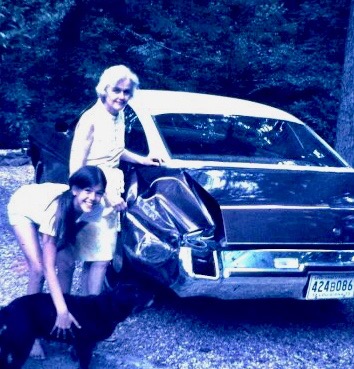
Exhibit A: Me—twelve, Mom—fifty-four, family pooch—we’ll call it six. Her name, the dog, was Butchie, largely because the Mattingly dogs who preceded her, all male, were called Butch—Butch the first, Butch the second … George Foreman style, and if the tradition can be feminized, why not? The car (or perhaps victim?)—a convertible Cutlass, circa 1970. It belonged to my brother George (imagine that, Mr. Foreman), mid-twenties at the time and two years married to his lovely wife, Connie. Wait, it’s possible Connie brought the Cutlass in question to the marriage, a sort of dowry-like perk. Memory fails, but let’s go with that. It makes a better story, and for sure, I’ll never forget the happy couple’s gnashing of teeth after the incident that left their racy little Olds bashed at the hip …
Late spring or early summer, from the looks of my outfit, sunset of my seventh grade year, and apparently I’d set my sights on the Twiggy award (all arms, legs, and stringy hair). Late afternoon, as I recall, and I’m hanging out in our family den, a bag of potato chips and onion dip close at hand, maybe huddled over a pre-Algebra problem, maybe watching a “Brady Bunch” re-run, most likely fresh off the (rotary) phone from lamenting to a similarly pre-pubescent friend that my crush-of-the-month only had eyes for Laura or Cynthia or one of three other classmates more Bridgette Bardot-like, even at twelve, than Twiggy.
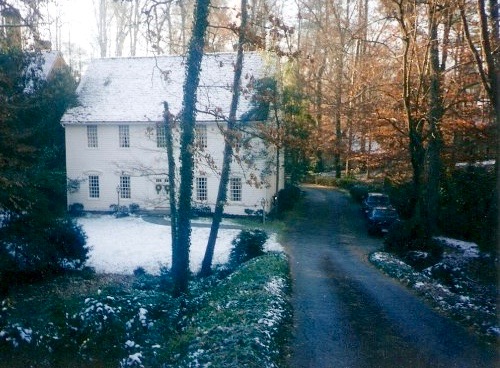
Suddenly, a high-pitched scream outside, at first faint then gaining volume like an oncoming train. I drop pencil and Lays and bolt out the back door, Butchie at my heels, to driveway’s edge. Our driveway (see Exhibit B below), ran about forty yards straight down at a precipitous angle from the street to our house in a hole, as I used to call it, a hole created in some long ago millennium by the babbling creek that flowed five to ten yards, give or take, to the right of said driveway. Just below driveway’s crest, a pile of mail in her arms and pocketbook swinging at her elbow, my mother chases as if to rein in with magical maternal powers her lemon yellow Electra, a popular boat-like Buick of the day. The Buick rolls merrily along, self-driven, ten feet ahead of her. I grab Butchie’s collar and freeze. The car seems more runaway cartoon buggy than dangerous projectile, and I sense in my mother’s screams more panicked embarrassment than fear. Sure enough, the hulking Buick all but eases over the wide drain at driveway’s base, where rainwater sluices away on a stormy day. Rather than careen toward the pup and me, she veers right, groaning, and comes to a cacophonous yet somehow graceful stop, her fall, so to speak, broken by the unlucky Cutlass situated in the handy parking slot my father cleared years before above the picturesque creek.
The Electra’s treacherous path (note double parking slot to the right)
“Two cars! Two cars!” my mother hollers, spectator pumps slapping gravel and knees knocking beneath the hem of her skirt. Two car crash, she means, and the fact that she, whose exercise regimen features climbing steps and roaming the mall, has survived this descent without serious injury is perhaps most astounding of all. Her arms are empty now, spilled purse and mail littered across the drive, and she flails those arms overhead like a mad wing walker flashing his orange baton on a tarmac. I think I smile a little even then, because honestly, though this will be an expensive mistake, one that might have been tragic, it really is funny.
Moments before, the Electra’s trunk stuffed with grocery bags, Mom pulled over the raised lip that joined driveway to street and stopped, as she’d done countless times before, to fetch the mail. She mashed the emergency brake with her quad A, size 6, foot, opened the door, stepped out to the mailbox, and, ooh la la, there she went, Old Electra, smelling the barn and waiting for neither man nor dreamy woman. The gear shift, my mother surely thought. Did I put it in Park? She did not, and thus did the yellow workhorse begin her joyride home, happily slowed by that emergency brake. How was she to know my brother’s muscle car had claimed her favorite stall?
I wish whoever snapped this Kodak moment had included old Electra, whose escapade left her with quite a shiner (think of the Instagram likes Mom might have earned!), but otherwise, I love the old crash photo, grainy and blued as it is. I love the dense foliage in the background that was the leafy oak that used to shade my friends and me in the creek below as we hopped from rock to boulder, building dams and creating imaginary villages. I love the tall tree trunk to the right, one of so, so many towering pines in our Georgia yard. I love having a pic of Butchie, RIP ole girl, with her graying beard, and mostly, I love the amused look on my mother’s face, the hint of guilty delight that says she owns this crazy humiliating moment, much the way she owned others during her long wacky years of rearing six children.
It’s funny, I don’t remember much anger associated with the Cutlass caper—check that, George was pretty stoked, but who could blame him? I associate with it instead one of my father’s exasperated shrugs and the eye roll that often followed. Needless to say, our family weathered troubles much more serious over the years than a two-car crash (though how it must have stumped our insurance agent–who/what was at fault?). We weathered times that in the moment weren’t funny at all, but somehow, most of our dysfunctional moments did, in the retelling at least, dissolve into laughter.
It was all about sense of humor, and the fact that my mother and father managed to keep theirs, through better and much worse and even as they aged and life grew close and dark. That legacy is something I thank them for, every day.
Ed and I and apparently, an early edition Twizzler, Summer 1967Somehow, we’ve been slung around the sun yet again and here it is, May 3rd. Earlier this week, I decided NOT to write about my big brother Ed, who died on an Atlanta May 3rd very like this one–bright, breezy, warm but still spring fresh, the air just a touch heavier, loamier than a week ago, way back in April. I mean, enough already! I’ve written about Ed before. The Attic faithful know all about his misadventures as a Marine in Vietnam, his “punny” way with words, his painful yet contemplative death (see Brother, Brother in the side bar!). What’s more, my MacBook is in hospital (wine spill and the drunken slash symbol now dances mercilessly across the screen), and writing (never mind, creating) on this effing PC borrowed from my husband’s office is proving the adage that you can’t teach an old hack new tricks. (How the heck do I UNDO an action? Moments ago, I hit something in the vicinity of the “numlk” key and deleted this entire post and had to start over. And don’t get me started on the backwards scroll bar …)
So I reckoned I’d bow out of this one, skip the ten-year mark in this age when no one with a shred of social media self-respect would miss the chance to celebrate an anniversary so post-worthy. I stayed strong through my second cup, especially after my initial efforts to navigate Google Chrome on this blasted machine left me in knots. I took a good Ujjayi breath and headed off to Wednesday yoga in search of some balance. A few Warriors, a couple twisting Chair poses, way too many Vinyasas, and it happened. As the class contorted with a collective grunt into pigeon (pidgen?), the music (which I’d hardly noticed before, as any good yogi wouldn’t) transitioned to a breathy version of “A Whiter Shade of Pale.” I jerked up my head, made awkward eye contact with my neighbor, snuggled back over my Gumby hip. A chart-topper for years in the UK and Europe, the 1967 Procul Harum original made it only to number five in the States. You don’t hear it much these days, but it was Ed’s Numero Uno. He played it as vinyl, eight track, cassette and CD. He sang it A Capella (and out of tune) ALL THE TIME.
Maybe it was magical thinking, maybe a fleeting moment of Nirvana, but of a sudden, Ed was right there on the mat beside me, slinking his long limbs into their own Twister trick (a game he excelled at, as he did most games). I closed my eyes and smiled, relaxed into the lyrics as they came in his deep playful voice–We skipped the light fandango, turned cartwheels cross the floor …
How could I take this as anything less than a cosmic nudge? Just like that, I determined to come home to do what I’d vowed not to, write about Ed (though for me, in brief, wouldn’t you say?). I don’t know, maybe big brother wants (certainly deserves) at least a nod on this day when so many across the country are thinking of him, missing him, laughing to themselves to remember his jokes and his ironic grin. There’s his widow and daughter and grandchildren in Oregon, our brother in San Francisco and sister in Pennsylvania, his many loving in-laws in New Orleans, his nieces and nephews and friends all over, and of course, those of us still in the city he loved–two more brothers, a son, the youngest daughter and their families and of course, moi, the kid sister (whose children adored their Crazy Uncle Ed).
This morning, many of us shared the usual email thread, a few photos, to reminisce. And just now, my niece reminded me that ten years ago, as we let fly Ed’s ashes over the chilly mountain waterfall where as children we used to swim and dive and scare our mother’s hair straight, Procul Harem played on a boom box balanced on a strong and solid Carolina rock.
Which leads me to believe maybe a few other folks heard Ed today, too, … as the ceiling fell away … and hewandered through his playing cards, calling out for more …
Ed, who had a way with kids and babies, holding my daughter, Emma, a few hours after her birth.
Attic Fans: I’m honored to welcome Laura Schalk as my first guest blogger. I like to think of Laura, a lifelong bookworm raised in Poughkeepsie who now lives and works abroad, as my very own American in Paris. We met a decade ago at a writers’ workshop held not far from Hemingway’s old haunts on the Left Bank. Thanks to the bottomless generosity of one of our workshop members, we and six others from that initial group have continued to gather each summer to work, study, write, eat and laugh together in Bordeaux. (And the local grape, we enjoy a bit of that, too.) Despite the miles that separate us, we have become the best of friends.
Like me, Laura lost her mother a few years ago. Like my mother, Elisabeth Schalk was a discerning reader who had a flair for fashion and a tendency to hold tight to what she loved, be it a shiny pair of patent heels, a box full of paperbacks, or her beloved family. Laura’s tribute to her mother here is graceful and true. I hope you enjoy reading it as much as I have. And by the way, Laura writes insightfully hilarious short fiction, too. Be sure to check it out through the Amazon link that follows …
With my mother and her mother, and my brother Peter behind, circa 1970. I still have Mom’s Icelandic sweater. Much to my regret, the groovy shades have vanished.
Martha and I have chatted many times over the years about our mothers: when they were alive and when they were dying, and later as we were coping with their deaths and with the resulting need to plow through the detritus of a beloved and fashionable woman’s years on the planet. Across two continents, we’ve shared the attendant emotions which that particular and at times painful task has stirred up – laughter through the tears and all that jazz.
When I read the first installment of “My Mother’s Attic,” I was jerked through space and time from sitting in a chair in my living room in Paris, to sitting on the floor of my parents’ bedroom in Poughkeepsie, New York, heartsick and hot and dusty. My mom was still alive then but in a nursing home, and far gone with Alzheimer’s. My dad had decided to put the family house up for sale, and I had flown back from France to spend three days going through Mom’s stuff.
Although this had taken place several years before, as I read Martha’s blog post, suddenly there I was on my parents’ bedroom floor again, pulling pair after pair of black size eleven shoes out of the cupboards that lined the baseboard. Black flats, black sandals, black loafers, black half boots – dozens and dozens of pairs, all stretched and worked and bearing the marks of Mom’s dear feet, some emitting puffs of dust and others disgorging dead flies or hornets. (At the Lutheran Care Center, my mother and the other residents on her ward wore white sneakers with Velcro closings, though very few of them walked at all.)
While I worked, my dad holed up in his study downstairs and left me to it. My equipment: a box of extra large black Hefty garbage bags, a marker, post-its, tape. After tossing most of those damn shoes, I dove into closets and drawers full of my mother’s clothes. One of the tics of Alzheimer’s is that people tend to re-buy the same thing, and Mom was no exception. I found stacks of barely worn pastel Eileen Fisher dresses, identical black “agnes b” separates, and bushels of handbags. I shared out a dozen pair of black leather gloves amongst my girlfriends, and returned home with twenty purse-sized bottles of Purell. Dad and I made multiple trips to the Salvation Army in downtown Poughkeepsie, unloading our flotilla of garbage bags from the back seat and trunk. To cheer each other up, we told ourselves that women from the area who were looking for jobs would find their happiness and good luck in interview outfits, courtesy of Mom.
Mom was an avid reader throughout her life. Here are a few of her best old books, one with her inscription.
Each day during this seemingly endless process, I cooked elaborate meals – magret de canard, frisée salad with lardons, crab salad tucked into beefsteak tomatoes, the mayonnaise homemade. Dad and I brought out the good china and silver and crystal (including glasses Mom never let us use) for both lunch and dinner. Between bouts of cooking and sorting, I meandered through the house putting post-its on chairs, paintings, a desk, that read, “Laura – Paris.” At the time, this seemed a momentous and never ending task and I struggled to see the point of shipping all that stuff home.
And yet, as I prepared the other weekend for a dinner party, I set the table in my flat on Rue de la Chine with my parents’ wedding silver. I put tapers in some candlesticks that used to grace the dining room table of my youth. I didn’t serve my friends anything as refined as the meals Mom would spend a day preparing (Julia Child’s coq au vin, lemon-lime soufflé), but I felt joyful carving my basic roast chicken on a lovely old Willowware china platter. And when my friend Nadia had a recent dinner party of her own, I brought a few things along … we ate Berber chickpea stew (a recipe from Nadia’s mum), served on my parents’ pink linen placemats with matching napkins. I’m sure my mother, ever the expert and gracious hostess, would smile to see her old treasures being used in other’s homes, and used again.
It may be reductive and even ridiculous to state that my mother is dead but lives on through her wool coat, her books, or the much-mended eight foot long white linen tablecloth she rescued from the dissolution of her own parents’ home. But still, to this day I can’t leave the house without wearing or taking along some item of Mom’s: a ring, a bracelet, a slippery Hermes scarf that I never can tie with her Seven Sisters’ insouciance. And when some months ago, the chain to one of Mom’s necklaces broke as I was getting dressed and the pendant dropped to the floor and rolled from sight, I wept. I crawled around on all fours searching until, already late to my meeting, I had no choice but to give up. I shoved one of her rings on my finger, reapplied mascara and left the flat.
As time passes, I continue to muse about the lingering power of objects that have been owned, held, chosen, worn by our loved ones. Is it unhealthy, superstitious to confer such mojo on material things? Perhaps. Probably. And yet, in amongst the clutter my mother left behind, there were multiple potent talismans, enough to buoy her daughter, to propel her through the days ahead.
My dear friend Tracy (left) and I at the Paris Women’s March
Gathering beneath La Tour Eiffel
POSTSCRIPT: As I prepped for the Women’s March in Paris last week, I was sure to wear the t-shirt my father gave me years ago, one which sadly is now more relevant than ever, and says, “Women’s rights are human rights! Stop the Republican war on women!” But I also gave full reign to my mania for talismans and wore or carried a panoply of objects from beloved women and men in my life: bracelets, a necklace, earrings, a pin, a flask and Dop kit and a handkerchief. Before I headed out, I tucked a water bottle bearing photos of my nephews in my knapsack and slipped my mother’s wedding ring on my finger, a thick gold band whose inscription is still visible: “Amor vincit Omnia.”
–Laura Schalk
Laura’s short fiction is anthologized in “That’s Paris: An Anthology of Life, Love, and Sarcasm in the City of Light” and “Christmas, Actually: A Holiday Collection.” You can find both at http://amzn.to/2jL4Oun.
My dapper dad, in his late twenties.Today, October 9th, 2016, would have been my father’s 102nd birthday. I’ve written about him and his tumultuous life here before, a few times over, so I won’t wax on. I’ll post a few photos, though, sort of a “Souvenir Sunday” in his memory, or his honor, or both. Thirteen years since we lost him, and I still miss his wry humor, his balanced and intelligent guidance, the devilish grin he liked to flash early mornings, when he was the only one in the house in a good mood.
Officer Mattingly in his Army greens, circa 1945, admiring my older sister.Well of course I miss him. He was my father, and yet, for the first time since his death I forgot to think about him, or the fact of his birthday, until I’d been up and out of bed for a solid two hours. Around 9:30, I opened my phone and my eye registered the date. Wow, I thought, and felt a flush of shock and shame. Time’s funny that way, isn’t it. You lose someone, a parent, a sibling, a lifelong friend, someone so fundamental to your being you can’t imagine living on after he or she is gone. Still, you have no choice but to do the laundry or write the article or move the child who is no longer a child to college and the years slip by and you wake up one day to realize hmmm, you’ve done it. You’ve survived, and wonder of wonders, it’s happened almost without your knowing it. You’ve simply lived, rearranged your day-to-day in ways that have eased the sting, plugged the holes and filled up the spaces that once felt so gaping and raw. It’s not so much that the spaces are gone, or even that time heals. It’s just that time is time. Like it or not, it chugs past and most of us, the lucky ones I guess, can’t help but jump on the running boards and hold on for dear life.
A favorite of Dad from his golden years, with my daughter, whom he called “Emma Liz.” It reminds me of the shot of him with my sister. Twenty years later, Emma still keeps it in on her dresser.Besides … I have the Attic! Or more precisely, the Attic’s scattered remains that have found new life here in my house. Thanks to Mom and her inability to clean out when cleaning out was called for, I can time travel, nostalgically speaking, and have a little visit with Dad. So I made myself a hot cup of Lipton tea–his signature drink–and began shuffling through stacks of photos and letters. Just seeing my father’s face, and especially his handwriting (Miss Martha A. Mattingly, he scrawled across an envelope meant for me during my sophomore year in college) lifted my spirits. His script is hurried but generous, with little white space on the page, and it strikes me now that this was just like him. My father always was a man on the move, a Puritan work ethic-in-motion who wasted not and always kept his tee’s crossed and his i’s dotted. But he braked for family and friends, my father, and that made all the difference.
Letter from home …
October 5, 1979
Here’s the letter Dad enclosed in that envelope from my sophomore year. He wrote it October 5th, just before his 65th birthday. Apparently, I was headed off for a weekend with friends rather than coming home for the family bash. (What was I thinking? Sixty-five is a big deal!) Note to my whiney mother-self: Dad took this news with good humor and wished me a happy time wherever I was going. There’s nothing special about the letter otherwise–he and Mom were off to the Symphony that night, he was enclosing a check to help with my “tight finances” (which they weren’t, thanks to him), and he sure appreciated my phone calls whenever they came, said they brightened his spirits, “put life back” in their big, quiet house.
Dad and I, circa 1976, in a garden somewhere in England, on one of the many trips abroad that as the “baby,” I was lucky enough to be part of.I imagine that house felt plenty big and quiet, much quieter than I knew. Our youngest is now in his senior year of high school, and I feel his leaving already, his Pottery Barn Teen bed shrinking around his broadened shoulders, his keen mind yearning for space and freedom to question and grow. The unoccupied corners of our house now loom larger, blow a little draftier each day. But there’s good news. In one way, I take after my mother. Between the kindergarten artwork and piles of yellowed report cards, the baseball lineups and class photos and Playbills I’ve collected from our family’s younger days, I have plenty of sorting and tossing, and yes, safekeeping to do, more than enough to keep my mind off of all these empty rooms as Time does its thing, and chugs on.
The House that Sara Built, two weeks before it was sold
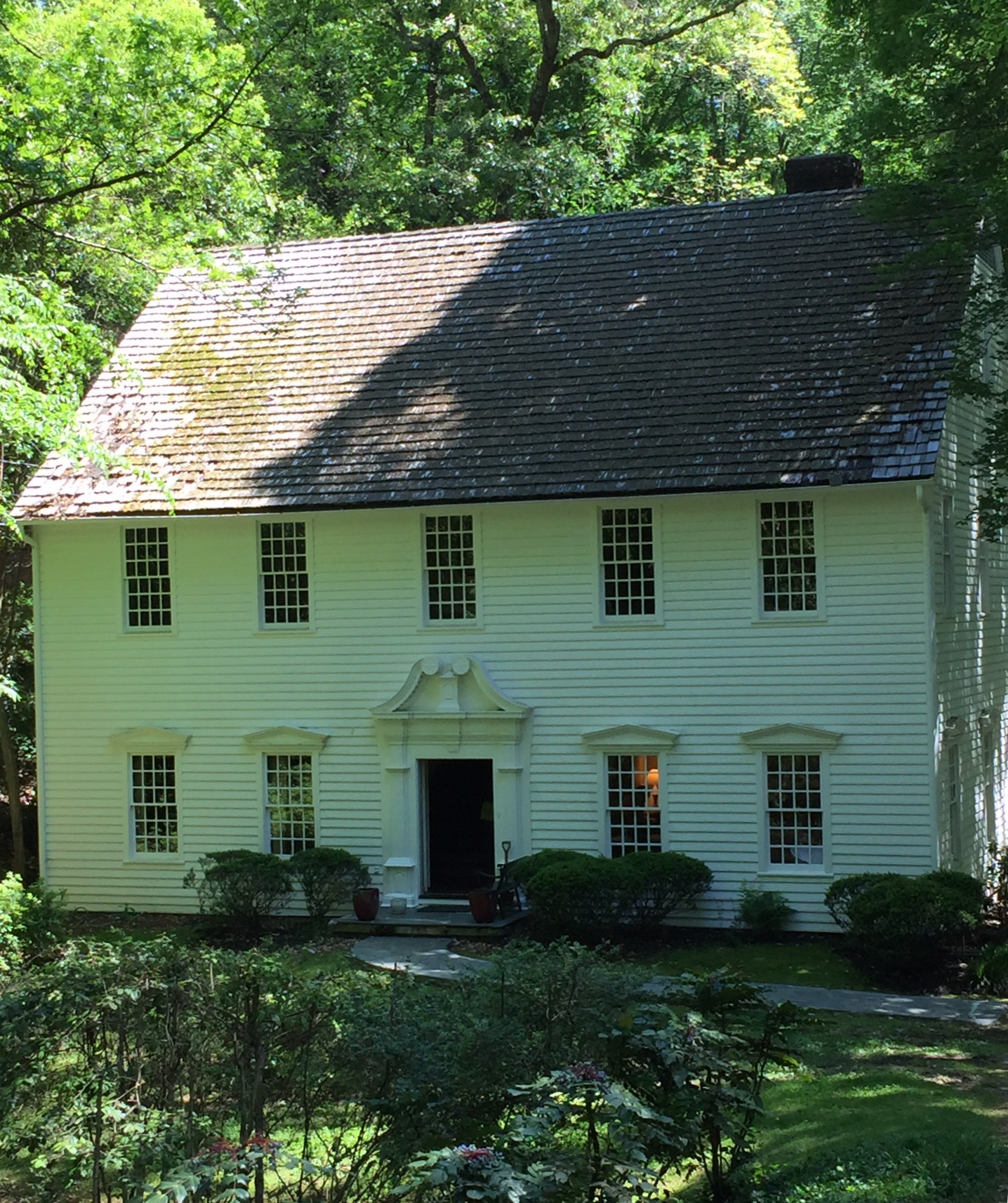
I’ve been rummaging again, though not in that drafty mildewed Attic that had me pushing Kleenex up my nose while I worked. Funny the way I miss it now it’s no longer mine to sneeze in. And yet, I avoid the drive-by. My husband chuckles at this. He likes peering down at my parents’ old house to see what changes the new owners have made. Sacrilege! All of it! Stone gargoyles now flank the front door … gargoyles? To accent its Early American design? Worse, the Attic has sprouted dormer windows. Yep, right across the once-so-elegant roofline (see photo exhibit A), three holes have been gouged out of the wood shingles my father paid so dearly for. One quick glance and it’s like I’m looking into Mom’s sad blue eyes on a rainy afternoon. My mother is a house, you could say, not to get too Faulknerian about it. She is gone but her beloved home, a little baffled by the sawing and hammering of late, remains. I understand now why houses are sometimes handed down like a Bible or a gold locket. If you could hug a house, I would. I’d drive by every day and press that brave Deerfield facade right up against my heart.
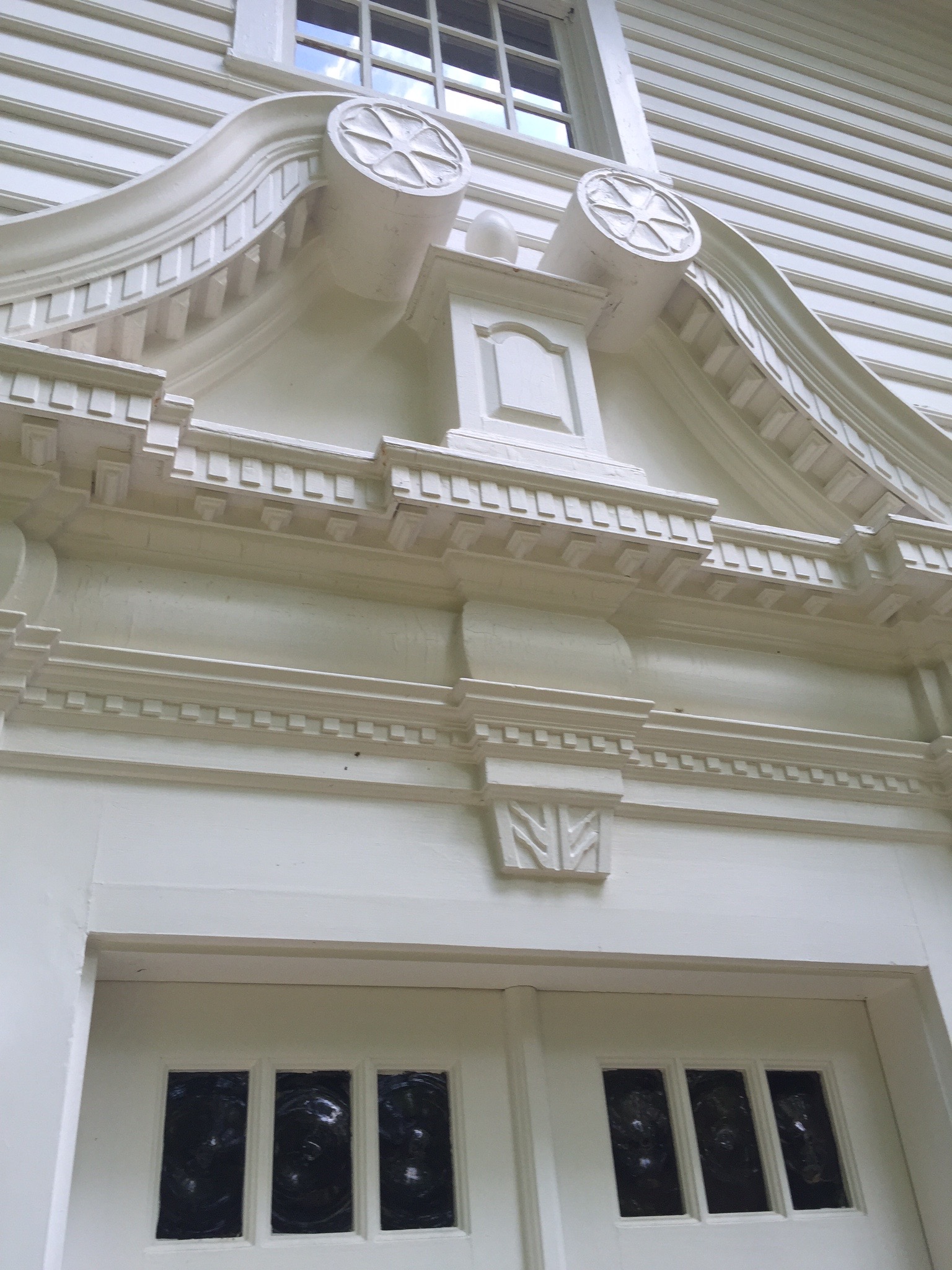
The doorway, copied exactly from the historic Ashley House in Deerfield, Mass. My father loved to elaborate on its unique design to unsuspecting guests.
Let me start again. I’ve been in the virtual Attic, sorting letters and photos and pondering the family legends they bring to mind. Surely every family has them, those tall tales that get batted about the generations. Remember how Mama, a flower in her hair, met Daddy hitchhiking to Woodstock? Then there’s sweet sister Sue, who broke the school bully’s nose, and how could we forget the night the police picked up Uncle Pete for swiping a television from the Ramada Inn? These stories are not my own, but they ring true (okay, the stolen TV bit might be from the Mattingly archives. Only the names have been changed …) .
The youngest, I was all ears. Our legends helped me knit myself into a family tapestry that was all but sewn up before I was born. In Mom’s Attic I find the finishing stitches. See this yellowed newspaper clipping, and that tattered telegram? Proof! The stories are true! Or mostly true. Odd discrepancies have arisen. My mother, neé SARA Elizabeth Lee, loved that her parents dropped the “h” in her name. Is this reason to brag? To her, yes. A late convert to Catholicism, Mom disliked being associated with the Biblical SaraH. Never mind this SaraH was known for her beauty, strength, nobility–heck, she was a princess! Did Mom OD on the Bible stories of her Southern Baptist upbringing? Was it because SaraH was oft celebrated as the long-barren wife who gave birth at age ninety? (Yes, 9-0!) How distasteful, my mother would have thought. She didn’t believe in getting old. And she took great pride in being fertile as a salmon. Delivered Baby #1 at twenty-four and barely came up for air until I came along at forty-one.
So SaRA my mother was, H-less and thoroughly modern. A bratty little spelling whiz, I used to playground boast about the special spelling, and oh, how I protested when mail arrived addressed to “Sarah Mattingly.” Mommy, they messed up again! Her bizarre H snobbery lived on. But then … my mother’s birth certificate, a document I now own, reads “SARAH Elizabeth Lee.” Hmmm. A transcriptionist’s error? Or was Mom pulling our leg? Did she, reluctant Sunday School attendee she was, dislike ol’ Abraham’s Sarah enough to drop the H? Apparently. Now where is that marriage license …
A rare photo of my father’s family, early 1930s. Known then as “E.H.,” he stands at left beside his father BENEDICT, step-mother, Stella, and half-sister, Anne. Older brother Ben and sister Marie complete the group.
Ironically, my father’s father, Benjamin Spalding Mattingly, was a name-tinkerer too. He christened his first-born Benjamin Lee, and my older brother is John Benjamin. No surprises there. But after Grandfather Ben died, my father unearthed his birth certificate. Ix-nay on the enjamin-Bay! Officially, he was BENEDICT. A Pope’s name! Why the cover-up? Did it smack of that traitorous American, Mr. Arnold? Another conundrum taken to the grave.
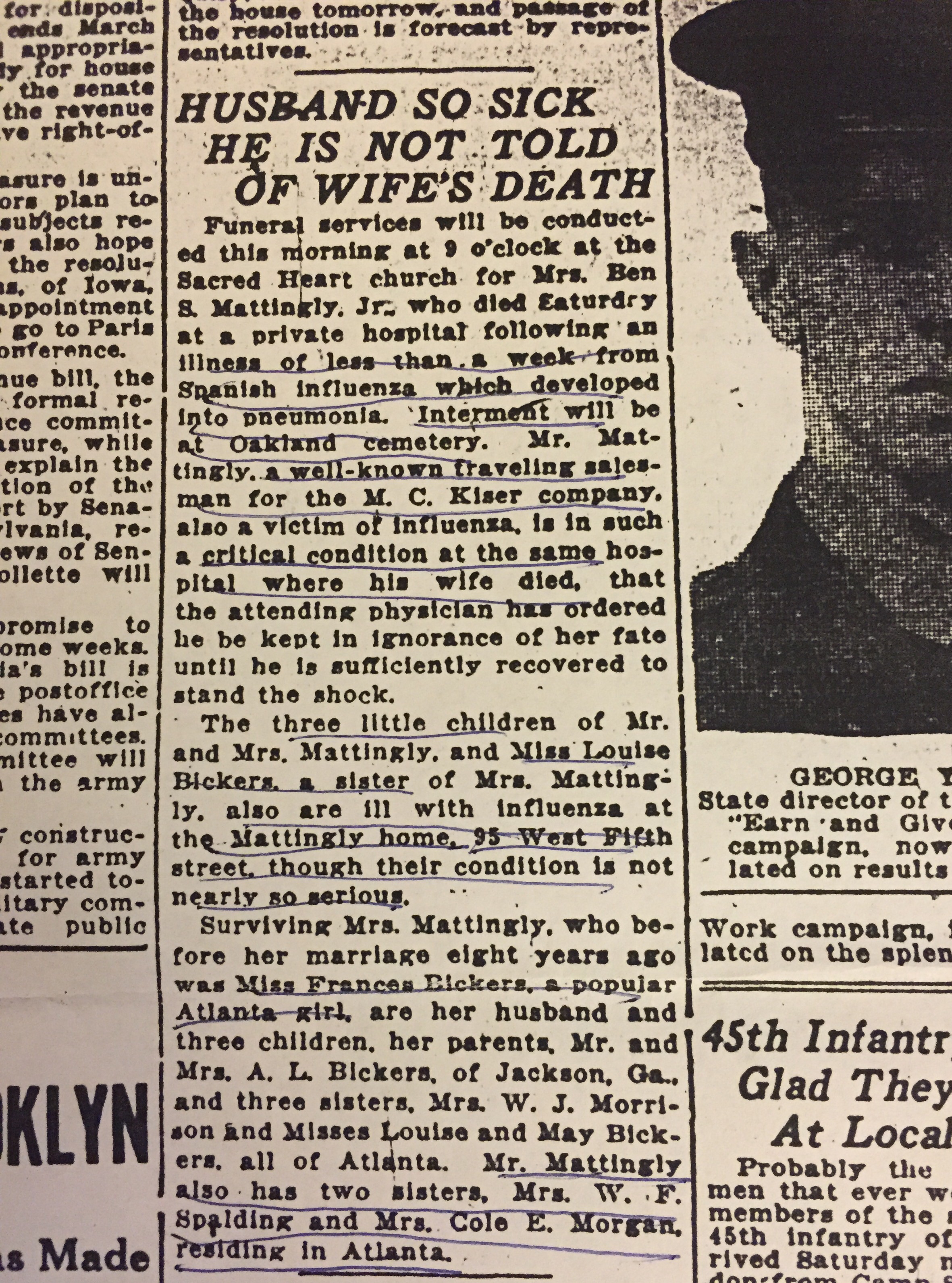
My Grandfather Ben(edict) died when I was not quite four. I know him only second-hand, through the handful of grainy sepia-toned photographs my mother squirreled away in plastic shirt bags. There are other stories, too, sad, even haunting stories. I’ve alluded in these pages (at least twice, begging your pardon) to my father’s difficult childhood. Chapter One: December, 1918. My grandmother, Frances, catches Spanish flu. Her entire family–my father, his siblings, my grandfather–are also ill. Days later, Frances, four months pregnant, dies in the hospital. A few doors down, Grandfather Ben is so bad off that my great aunts decide to keep secret the news of his wife’s death. As Ben gradually regains strength, my grandmother is anointed, mourned, buried. Before anyone works up the gumption to tell him, Ben begins working his way through the stack of newspapers some unwitting orderly has been dropping off in hopes of his recovery. Death is on everyone’s mind. The first World War just over, this flu is on its way to taking 675,000 American lives, far more than the war claimed and the majority of the victims in their prime. My grandfather turns to the obituaries and there, in the December 8th edition of The Atlanta Constitution, is my grandmother’s tribute. Ben’s wife, the child she carried, have vanished.
A dubious Attic treasure. From the Atlanta Constitution, December 8th, 1918.
A chilling story, one not to be believed, yet it must be true. The papers say so. “Husband So Sick He Is Not Told of Wife’s Death.” I suppose Grandfather Ben read that one, too. Like my father and uncle and aunt, he beat the flu … or did he? A traveling shoe salesman, he went on to fail spectacularly. He drank, a lot. He disappointed, as my great aunts might say. Some stories paint him as a Dr. Jekyll–sweet when sober, when drunk, prone to rage. In hushed tones, my mother used to tell us how he chased my father and uncle around the house with a butcher’s knife. No wonder the boys were shipped off to a south Georgia orphanage.
And yet, consider this letter my father sent home: “Dear Daddy … I hope you are well. I love you very much. I am having lots of fun with my bean bag and the games you sent me. I pray for you every day and often think of you … Daddy, will you please send me a couple of tops with plenty of string? Then of course Ben Lee will want a couple, too … Your darling boy, E.H.”
My one memory: I hold Grandaddy Ben’s hand. He is tall, with big leather shoes, crinkly skin, a firm grip. It’s a warm Atlanta day and we walk up the street toward the friendly white house with the fancy doorway where I have my own room and a pink gingham bedspread. I have no trouble keeping up because he’s old, tired. He coughs a lot. He smells of sweet vinegar. I skip and chatter and now and then, Grandaddy Ben smiles and nods and squeezes my hand.
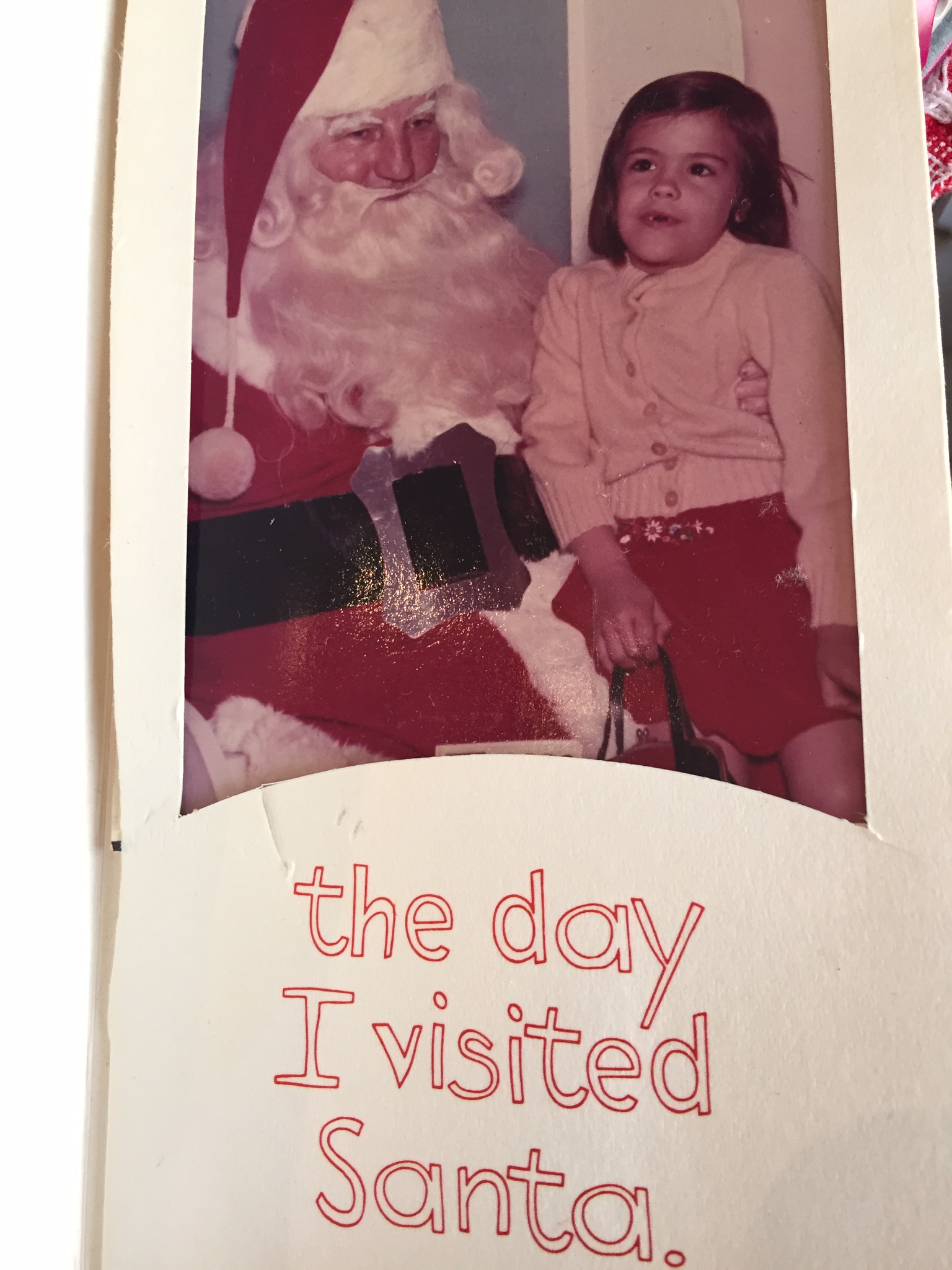
Two front teeth, please, and don’t even think about grabbing my purse. Circa 1965.
It’s happened again. Another big flashy holiday, the biggest, flashiest of all, and my pen, errrr, keyboard, fails me. What to write, how to say something fresh and worthwhile that’s not been said before? I noodled over a Thanksgiving post, The Holiday Table perhaps, and in it, creased snapshots from the Attic featuring me at ten, seventeen, thirty-two, gathered with my siblings, nieces and nephews, later my own children, around my mother’s Queen Anne dropleaf. In each photo, my father smiles, his specs aglint with the murky autumn light. In his hands, a sharpened knife, a serving fork, and before him on the linen tablecloth, a plump glistening turkey, a cornucopia of gourds or harvest fruit, an array of flatware and crystal …
1974. Funny, and my favorite.
Me at ten-ish.
And twenty-something.
Hark! Is that Norman Rockwell tap, tap, tapping at the door? Sub in a poinsettia or a bowl of holly (as my mother often did), tattered stockings by the fire, and soon we’ll have Tiny Tim hobbling in on his crutch.
So I skipped the Thanksgiving post. No matter where I went with it, cliché ensnared me like an unwieldy octopus. But in the weeks since, I keep coming back to these instant replay table pics, to those uneven smiles and sometimes weary faces. I think of the hundreds of old Christmas cards my mother saved, the bag after bag I tossed during last spring’s Attic purge, of the rescue bows and recycled paper, the rusted tree stands and broken ornaments.
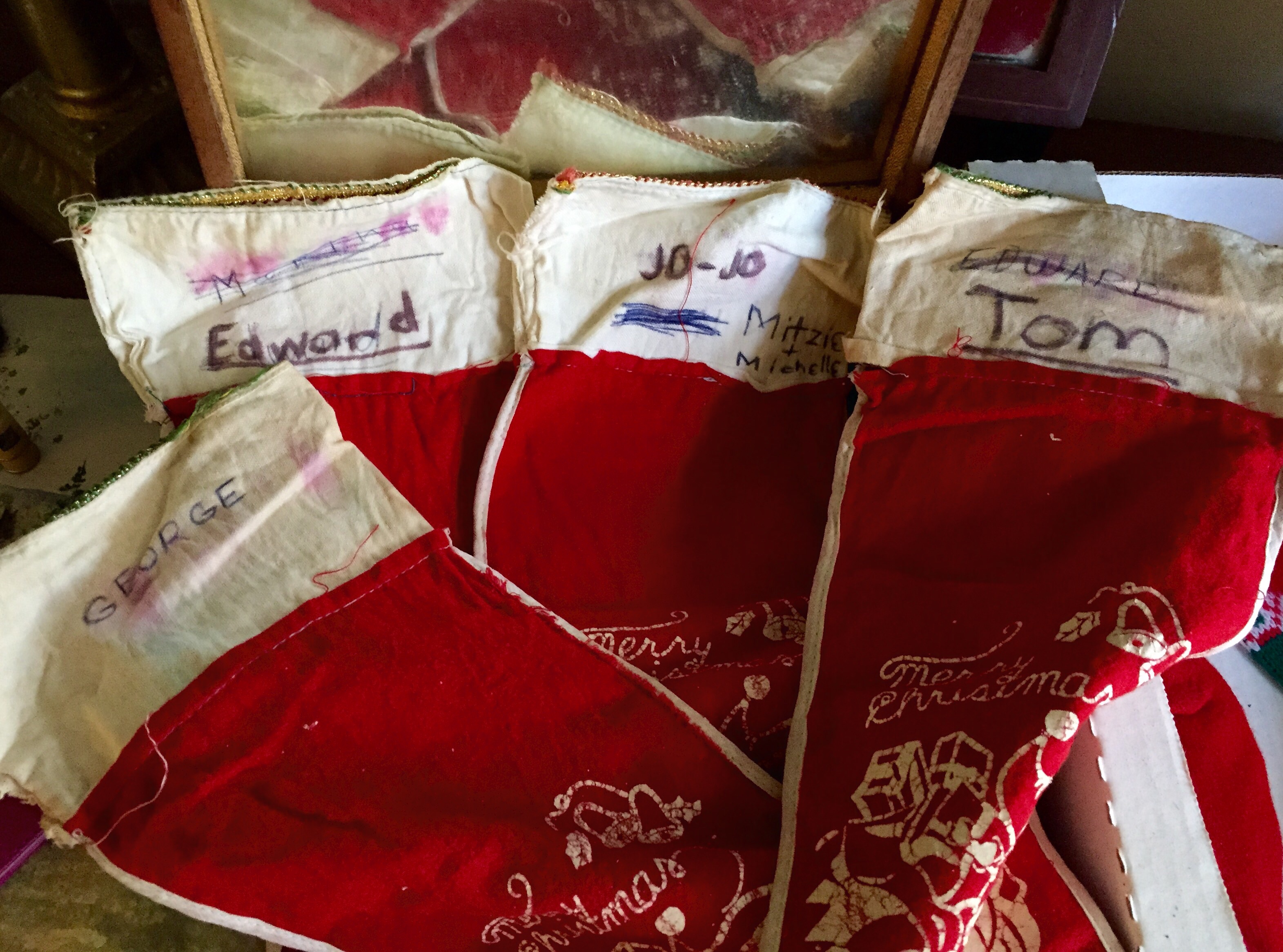
Peculiar as it now sounds, we waited ’til Christmas Eve to hang the stockings. The youngest, I was charged with fetching them from the Attic and updating the guest list, so to speak. With my handy Magic Marker I reminded Santa which of my adult siblings were currently in residence. Were we so destitute? Why not purchase fresh stockings as the family grew? It boggles the mind, yet this particular Christmas my sister-in-law had to share her loot with her daughter, Michelle, as well as with my sister.
My mother even saved used gift tags, a few of them from gifts my grandparents gave her when she was a child. These rustled up such happy thoughts. Oh how I loved to unload the box that arrived each year from our Florida grandmother. I took great care to arrange the gifts just so under the tree for my older brothers and sister to see. Who cared that Grandmom never bought us anything we wanted or needed? I looked forward to the yearly cotton handkerchief from my grandfather, always embroidered at the corner with something magical, a fairy tale cottage, a bouquet of flowers, a single daisy. I used to marvel, too, at my grandmother’s knack for wrapping gifts without using a single snip of scotch tape. Just paper and ribbon. I still don’t know how she did it.
A sampling of my mother’s gift tag collection
Greetings from your Milkman, circa 1962
One of the last times our brood was all together, sans my youngest. The ’90s, complete with tacky Xmas sweaters.
What’s that? It wasn’t about the gift, you say, not the present but the presence, the tradition? Bingo! The clichéd tentacle squeezes … Yet, how can I deny it? Christmas was big at our house, a day my father adored. He and my mother left us a wealth of moments to remember. Like all memories, some bring us joy now, some leave us sad. They’re stubborn little buggers, too, setting up shop in our hearts, our minds, our psyches if not our souls. So we laugh, we cry, we treasure, we curse, but by golly, as we gear up to take another spin ’round this beautiful scarred old planet, these moments will have their say.
Yesterday, I spent an afternoon in the woods, at a spot my Mattingly family grew to love during the last years of my parents’ lives. Each Labor Day for fourteen years, as many of the four generations strong of us as were able would fly in or motor up to spend the weekend together. We hiked, golfed, ate, drank, laughed, rocked, ate, drank and laughed some more. This past September, the first since my mother’s death, we weren’t able to pull the trip off. This cooked up a nice cocktail of conflicting emotion for my siblings and me. The torch had been passed and already, we were failing to carry on a cherished, if expensive, family tradition. No surprise then, that when out of the blue my husband planned a quick getaway to one of the cabins where on those Labor Days of old cousins and nieces and nephews slept and played, I was a smidge hesitant. Their fly fishing gear happily stowed in the trunk, husband and older sons drove up at dawn and I followed later, with a sizable lump in my throat. Still, it was a lovely balmy December day and minutes after I pulled in, I set off to hike to Duke’s Creek Falls. I’d hiked there dozens of times before with the family group, the wise and slow of foot and the young and energetic alike. The woods were silent by comparison, my journey wistful but sort of okay. Alone, I could hear the scamper of small creatures through fallen leaves, bare branches clicking in the light breeze, Duke’s Creek gurgling along.
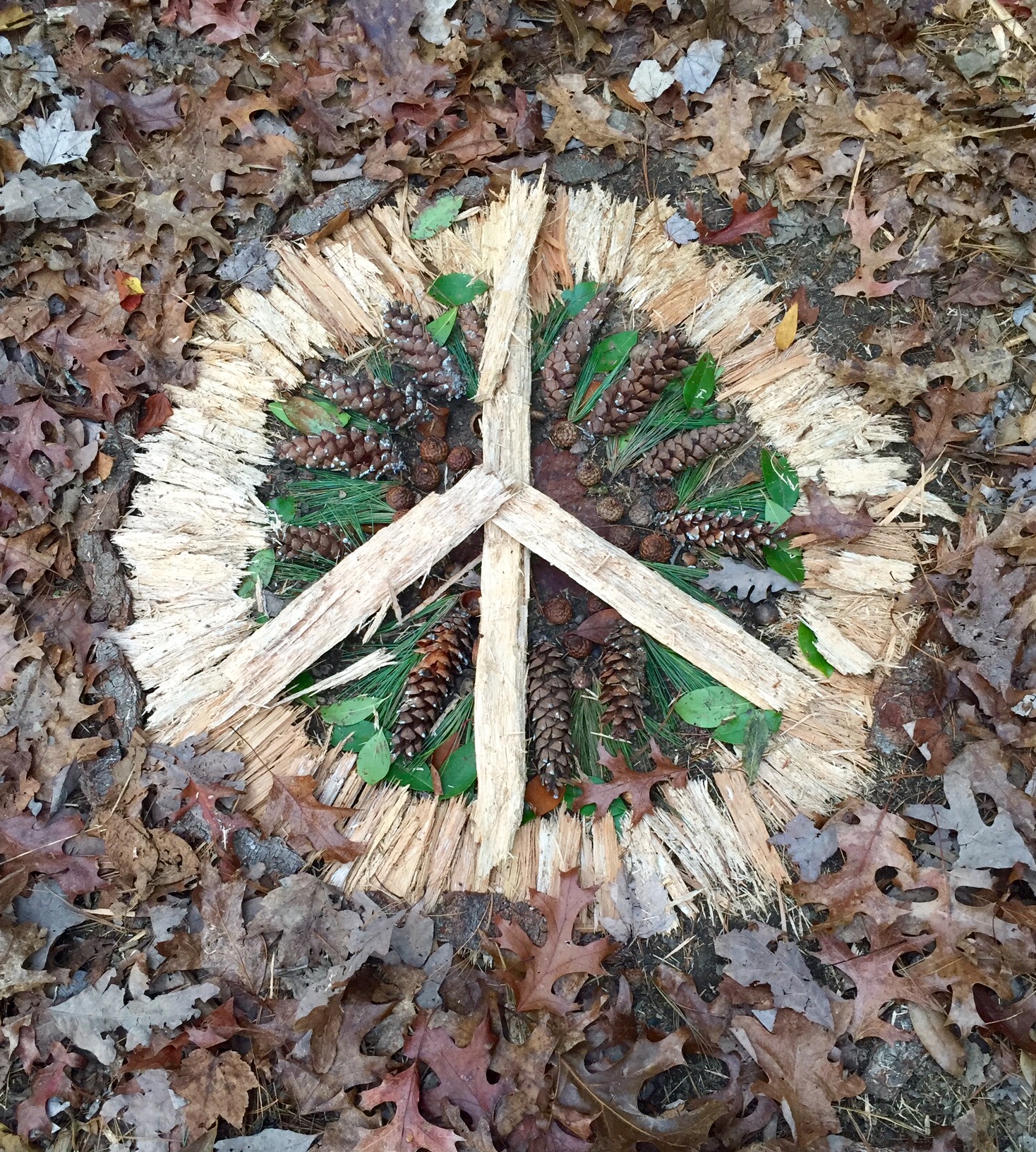
Then, I rounded a corner and there in the middle of the path was this–
Peace, on Earth. Literally.
Ah! Two feet in diameter, a tired symbol made new, a circle, a wreath! And one fashioned by hand (using the same holiday greenery I paid way too much for last week at Pike’s Nursery). What a generous soul, to pause and leave me, others, this, a moment to remember. I snapped a photo with my Iphone and hiked on. By the time I got back to our cabin, this post had nearly written itself in my mind. A good gift, and many thanks to my fellow hiker, wherever you are.
Peace, everybody, really. And good will. Hope your holidays are full of them.