Afternoons with Mary: “On my Mind and In My Spirit”

After nine long years of procrastination and skittishness, I’ve worked up the gumption to share the story of my rekindled relationship with the beloved caregiver of my youth. The story will unfold in several chapters. If you’d like to read the origins of this journey, just click here: I Am Mae Mobley


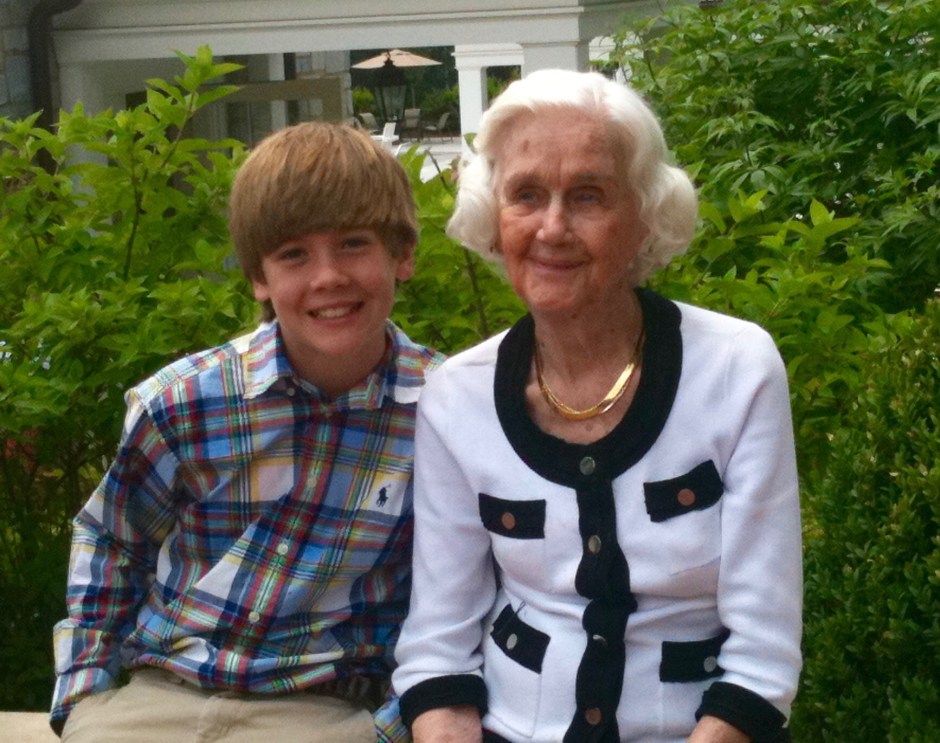
On a steamy afternoon during the troubled summer of 2016, I finally worked up the courage to call Mary Darian, the intrepid woman who half-raised me. Though I loved Mary dearly, I’d failed as an adult to stay in close touch. As each ringy-dingy sounded, I worried, whispering my introductory lines again and again. A waste of energy this. Mary knew my voice immediately—“Angel Face, is that you?” I pictured the tall, confident young woman who used to drive me to McDonald’s for a Big Mac after middle school, and let go a grateful sigh. I was no longer a school girl, of course, and Mary had long moved on from being our family’s housekeeper, but her voice still brimmed with warmth and affection.

I caught her up on family this and thats. We exchanged stories about my mother—“Now she was a real lady … ” Mary gave a chuckle. “And what a seamstress!” She’d long admired my mother’s knack with a needle, and one of her lively descriptions came to mind: Your mother made a white jacket for her new formal gown with shells around the midriff … she once penned to me at summer camp. Wow! When the lady moves, she gets momentum and never stops … I think she’s going to wear it with her sexy red sandals!

Though Mary had never much liked talking about herself, she finally told me she’d recently had a fall. “But Lou took such good care of me I’m already back on my feet!” Lou is Mary’s daughter, as loyal and kind as they come, and I noted as much. Hesitant again in light of this news (was this the time to worm my way into Mary’s life?), I took a deep breath and asked if I might drop by for a visit. “Why sure, anytime!” she said. Then a pause. “Well, anytime other than Wednesdays … I still get out for my Bible study on Wednesdays.” Smiling, I suggested the following Thursday and our plans were set.

Eighty then, Mary lived alone in the home in west Atlanta that she and her husband had moved into in the late sixties. A one-story with wood siding and four inviting windows across the front, I’d been there as a child. As I drove between sprawling azaleas lining the driveway and parked beneath the shade of a generous hardwood, I found it as cozy and comfortable as it was back then, only better. Previously a neutral cream, it had been painted a bright banana yellow. The shutters and trim, dark navy before, had gone lime green. The effect was bold and welcoming, as if the house itself wore a wry grin for neighbors and strangers alike. Perfect, I thought. Mary through and through.
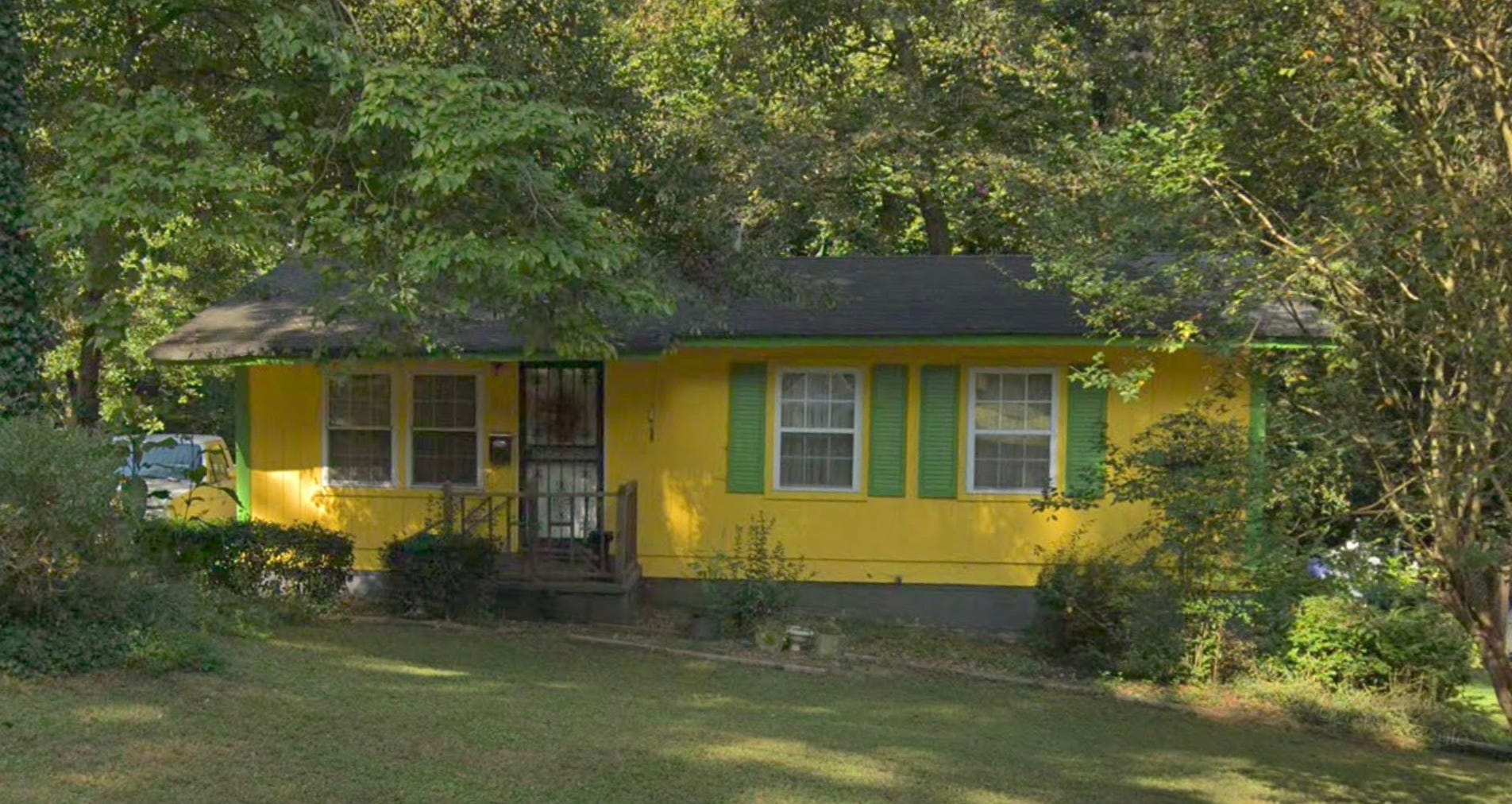
Mary’s home for over fifty years

“Come on in!” Mary said with a yelp of pleasure, and squeezed me tight. As we walked inside, she limped a little and gripped the back of a chair. I winced, reached to help, but she brushed it off. We sat side-by-side on her couch and studied the faces, many of them Mary-like, smiling out from the abundance of photos in her living room. One by one, she proudly identified family—the three sons I’d once known now become men, the late husband I never met, the many beloved grandchildren and great-grandchildren and of course, Lou, who showed up toward the end of our visit, sacks of groceries spilling from her arms as she corralled her little granddaughter through the door.

Mary had visitors most every day, family and more. She bragged on her neighbors and beaming, described the teenaged boy from her church who dropped in often to check on her. We reminisced about my parents. She asked about my children and my writing and just like that, the gap of years since we’d spent time together fell away. We joked about my older brothers’ teenaged exploits of long ago, and she said how sorry she was about the oldest, Ed, who’d been gone nine years.

“Your mama called me,” she said, her eyes damp. “More than once after he passed. Just to talk. A mother shouldn’t have to lose her child.”

“No, she shouldn’t,” I agreed, my voice wobbly. Mary took my hand and I mentioned that I’d been thinking about her a lot recently … “Especially since I rewatched The Help. Have you seen that movie?”

“Sure have,” Mary said, her tone wary.

“You know, it has its faults but it made me realize I never took the time to really get to know you … ” I began to sweat. “I guess what I’m trying to say is I’d like to learn your story, Mary. It’s something I should have done a long time ago. I’d like to know about you and your past, the way you’ve always known about me and mine.”

Her soft gaze clouded in bemusement, maybe disbelief. It wasn’t like Mary to be at a loss for words, and I looked away. Maybe I was being pushy. Maybe I should have kept my mouth good and shut.

“Well, honey,” she said finally, grinning. “It’s not all that interesting of a story, but I can probably come up with a thing or two.”

I laughed in relief, and we agreed I should return in two weeks armed with pen and paper and I-phone microphone. I wasn’t sure exactly what I would do with what she chose to share—blog? book? keep in my heart?—but I left excited about what lay ahead and hurried home to call my sister in Pennsylvania. Ten when our parents hired Mary at eighteen, JoJo loved Mary too, if in a different, maybe even deeper, way.
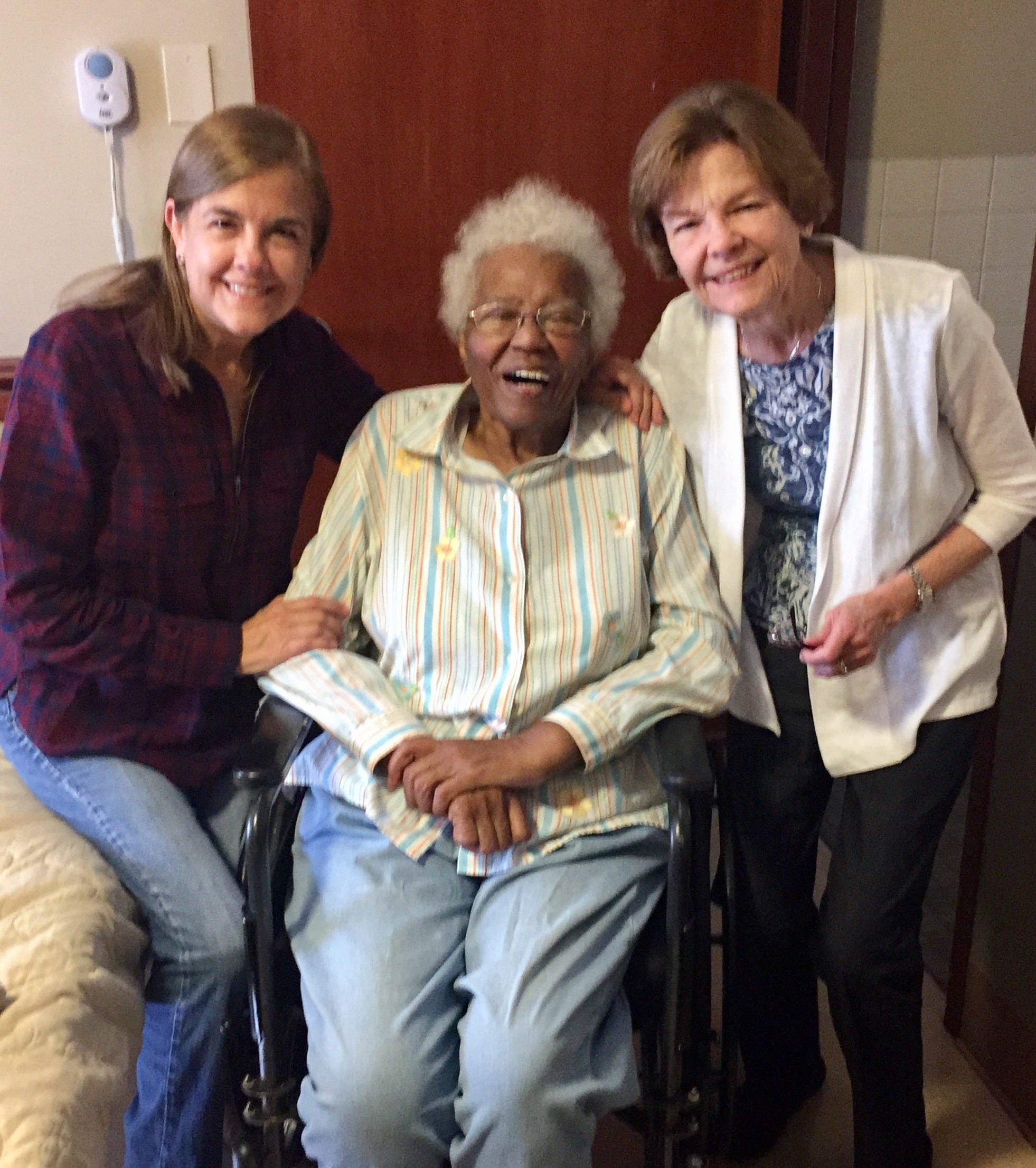
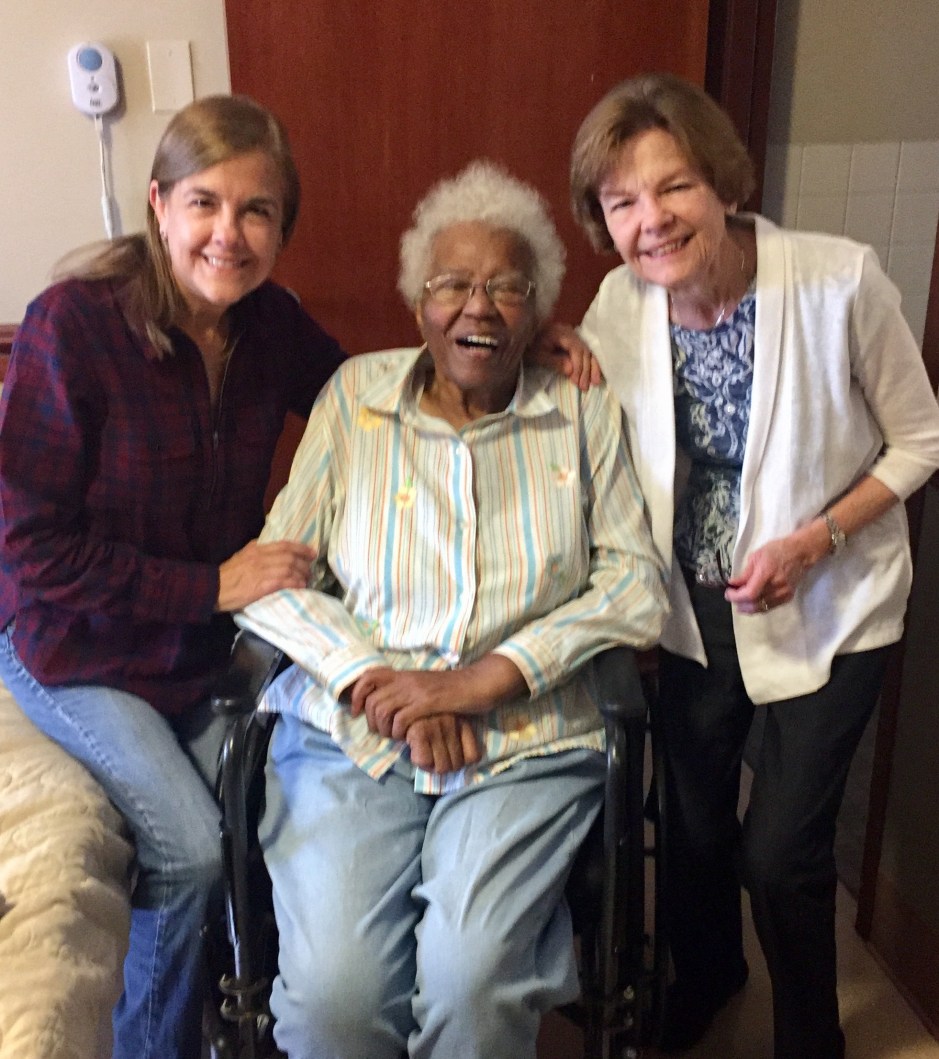
My sister and I visit Mary on her 81st birthday, November 11, 2016

A week later, Mary called, her voice subdued and full of pain, to cancel our get-together. Her oldest son, Lewis, Jr, had suddenly passed away of a heart attack, at fifty-seven. It was almost eerie, given what we’d recently said about mothers losing sons—such a cruel twist of time—and my heart ached for her. The fact that she’d lost her husband decades before in the same way and at roughly the same age only deepened her sorrow. My brother George and I attended Lewis’s funeral, a service filled with music and laughter and tears. During one of the soulful hymns, Mary, seated in a wheelchair in the front row, reached her hand toward Lewis’s casket and swayed in easy rhythm with the music. She was a woman of strong faith, among the strongest I’ve known, and I remember feeling that the air in the church seemed to shift, as if Lewis’s spirit had joined Mary’s own, and settled in to stay.

Not long after Lewis’s death, Mary had another stroke. I visited a couple of times at her rehab facility, once on her birthday when JoJo was in town, but we agreed to hold off with the note-taking and the rest until she grew stronger. The stroke had slowed Mary’s speech and in truth, I wondered if it might be best to leave well enough alone. We were back in touch, friends again, and Mary should save her energy to heal and live her best life. In the span of a few weeks, she’d given me a glimpse into her family life—who could ask for more? Tough as ever, Mary had something else up her sleeve. The next March, she reported she was much improved and ready to start getting together, only I would have to come to Lou’s house while she recuperated, which was peachy with me.

And so it began. Lou welcomed me to her home on our appointed day, and Mary, the walker she was learning to use close at hand, gestured me to join her on the couch.

“Angel Face,” she said, her trademark smile tinged with emotion. “His story has been on my mind and in my spirit.”

His story?” I asked.

“My daddy’s,” she said, touching the tight white curls around her still- smooth face. “I want to tell you my daddy’s story.”

She held up two pages of blue cursive notes written in the hand I knew from her letters, if a little uneven. I longed to hear about Mary’s life, and felt a touch disappointed.

“I’ve been trying to get it all down,” she said. “But I’m such a slow writer these days!”

“It’s hard for her …” Lou chimed in from the kitchen. “She spent days on it!”

Awed, I scanned Mary’s pages and it hit me: by sharing her father’s journey, she would be sharing her own in a manner she was comfortable with. Besides, do any of our lives make sense without the larger story of our parents and grandparents and on back?

“He was born in Hurtsboro, Alabama,” Mary began.

Hurtsboro—then a town of less than 900 residents wedged into a far southeastern lip of the state, deep in the Cotton Belt. Hurts to stay but it hurts to leave, Mary once quipped. The 1910s and 20s. The legacy of legalized slavery still shrouded the South, and Jim Crow was flexing his muscles. Mary’s father, Jimmie Lee Cochran, lived with his sister and their mother and grandmother on a white man’s farm. As early as the third or fourth grade, Mary explained, her father, “the man of the house,” often had to leave school early to go home and work the fields. Children being children, his classmates took note, in heartbreaking fashion, but a certain little girl understood Jimmie Lee’s predicament, and that would make all the difference.

Mary tells this best, so I’ll sign off for now with the brief clip above (apologies for the poor editing and annoying oohs and aaahs) in which she describes the moment her mother-to-be, Lue Milla James, first felt a pang of love for the boy who would become Mary’s father.

Home at Last

Like her father, once Mary earned the right to vote, she never missed the chance. Here she fills out her absentee ballot in October of 2018 for Georgia’s gubernatorial election.

Some of you met Mary Darian in “I Am Mae Mobley,” one of my early posts here in My Mother’s Attic. In part an outcry against an upsurge in race-related killings during the summer of 2016, that piece is at heart a tribute to Mary–the woman who helped my mother rise to the Herculean task of raising six children. Since I launched this blog, Mae Mobley continues to garner far more views than any other Attic post–testimony to Mary’s captivating character. In that earlier piece, I lamented that during the two decades Mary worked for our family, I failed to learn much about her life. I vowed then to make amends for this, to reach out to Mary, though I was more than a little nervous about cold-calling after so many years of silence. I might have known that was a waste of emotional energy. In the years that followed, in spite of facing one personal challenge after another, Mary shared detail after detail about her story, and more broadly, her family’s story, which to her were one and the same.

One morning not too long before the pandemic hit, I went to see Mary at the nursing home where she’d recently moved. Her room was small but comfortable–a sink and closet against one wall, a twin bed at the center, a broad window at the far side, the ledge below crowded with photos of her grand- and great-grandchildren. Mary’s devoted daughter, Lou, had a bird-feeder installed just outside the window so Mary could enjoy sparrows and robins and fiery red cardinals as they flitted about. By this point in her life, Mary was confined to a wheel chair, though I was soon to learn that in her case, confined did not apply.

I breezed through the door a little earlier than usual to find no Mary in sight. I heard a scuffle on the far side of the room and stepped closer. She had wheeled herself into the narrow space between bed and radiator and crouched low over her knees, her head nearly hidden between the bed and bedside table.

“Mary?” I asked, trying to control the worry in my voice. “Can I help?”

“Oh!” she said, her voice bright with enthusiasm as she looked up. “Angel Face!” (the pet name she coined for me as a baby). “Come on over here!”

I did just that. Mary craned about and reached her long arms around my neck. That’s when something shiny flashed in her lap–a long, thin metallic tool.

Celebrating Easter. April 2022

“Just give me a minute …” she said, ducking head under table again. “While I find my Puh …”

“Here, can I get it for you?” I asked, though I wasn’t sure what I was looking for. Her paper? Her pillow? I tried to maneuver between wheelchair and radiator but the space was tight, the bedside table happily cluttered–a card illustrated in blue crayon, a tub of Vaseline, a small glass vase filled with Alstroemeria, a stack of word puzzle books and a red leather Bible, its pages well-thumbed.

“What is it you need, Mary?”

No answer, just more poking at that shelf.

“Ah, here it is!” she cried at last. Turning, she sat up straight, her expression devilish and triumphant. “My Ponds!”

She held out the stick, which I then could see had a grip handle at one end and a sort of claw at the other, not unlike the mechanism in that arcade game in Toy Story (The claw is our master … ). Caught firmly in Mary’s claw was a jar of Ponds cold cream, same pale green cap and tulip logo as the ones my mother used to keep on her vanity table.

With easy dexterity, Mary twisted open the jar, scooped out a finger full, and chatting all the while, began massaging the silky cream into her still-smooth complexion. Her task complete, I offered to return the jar to its shelf. She laughed, waved me away, and did it herself, metal claw re-extended. Then she nabbed her hairbrush from the drawer, dropped it in her lap, and wheeled over to the sink. One of her feet–slightly swollen–nearly collided with the corner of the bed frame as she went.

“Mary, your leg–is it ok?”

“Oh that …” she mumbled as she set the hairbrush at the edge of the sink. “Some kind of blood clot in that old leg.” Then she plucked a cloth from a towel rod, wet it generously, and ran it across her short thick curls before brushing them out.

“Ok, now …” she went on, patting her head and smiling at my reflection in the mirror. “That’s better. I never know what it’ll look like in the mornings.” Then guttural laughter as she spun her chair around to face me. “Now tell me … What have you been up to?”

I gathered my thoughts, but before I got a word out, her eyes flew open wide and she cried, “Wait a minute! … I forgot my teeth!”

With that, and without a wrinkle of embarrassment, Mary spun back around, tugged a set of dentures out of a cup and slathered them with toothpaste. While she gave them a sturdy brushing under the faucet, I marveled at the independence, the lack of self-consciousness, and the serene acceptance of the time-consuming rituals of growing old that she possessed.

“Your mama liked Ponds, too,” she mused. “You know …” She paused and turned to me, that devilish smile restored. “She may have been the one who got me started with it!”

Whether this was true or its inverse–that Mary actually introduced my mother to Ponds–didn’t matter. This was a habit they shared, one I hadn’t known about, and something soft padded into my heart. Not a visit passed between us that Mary didn’t turn our conversations back to my parents, or one of my siblings–to those days she was part of the everyday workings of our busy household. She loved especially to wax on about my mother’s expertise as a seamstress, but then she’d been doing this since my summer camp days. Your mother made a white jacket for her new formal gown with shells around the midriff … she penned in a letter she sent off to Camp Merrie-Woode. Wow! When the lady moves, she gets momentum and never stops … Then, one of her witty after thoughts–I think she’s going to wear her sexy red sandals.

Back then, ten years old and homesick, I likely cried to read this, but it was a good cry. Mary was enfolding me from a distance into the home life I loved. I understand now that during our recent visits, she was doing much the same. Her smiles, her laughter, her stories, were keeping my mother, my father, in short, my childhood alive. She did me as much good–no, probably more–than I did her.

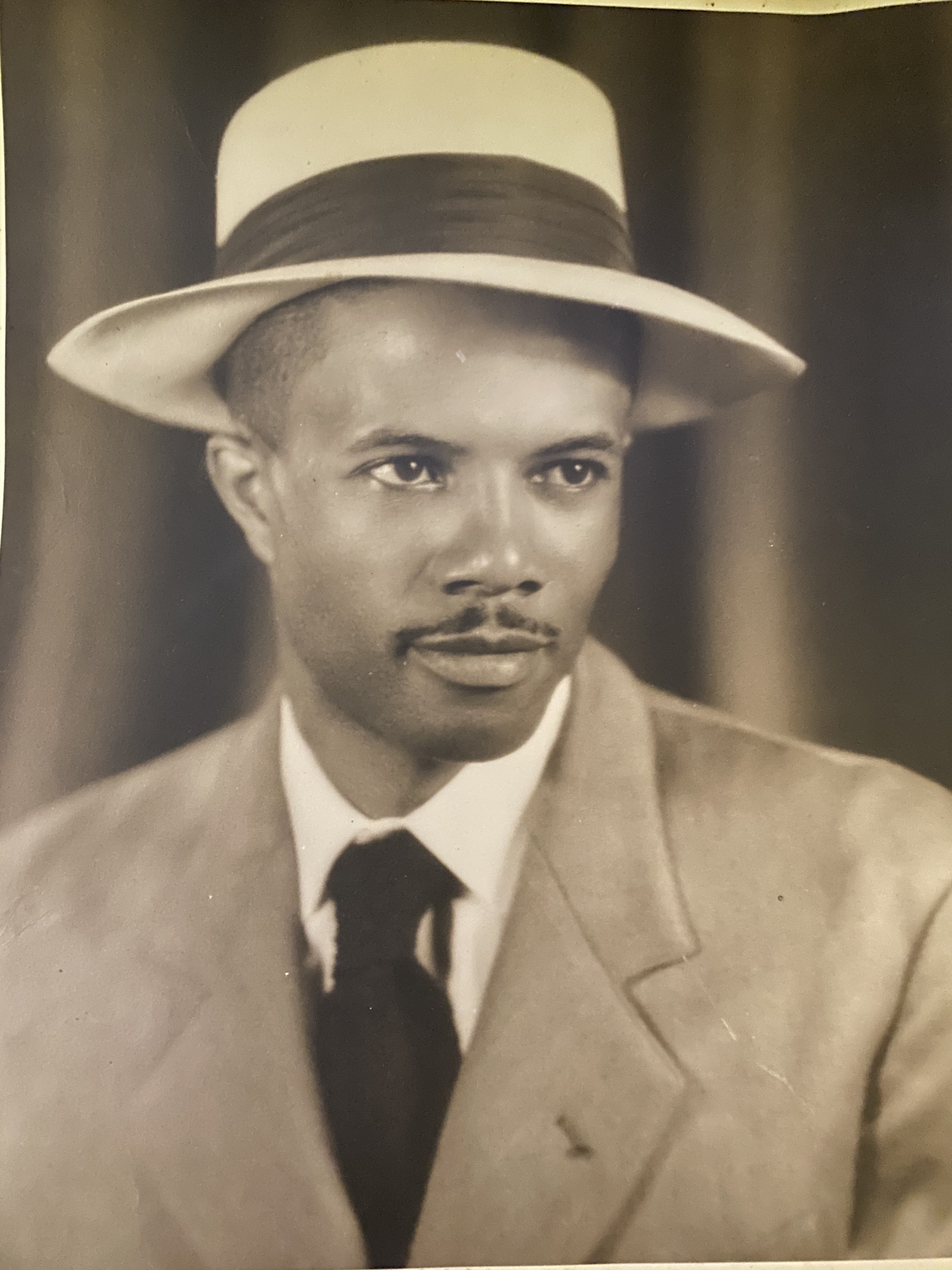
Mary’s father, Jimmie Lee Cochran, as a young man.

Though she lost her mother very young, Mary was eager to share her father’s story, too. In the 1920s, when he was hardly more than a child, Jimmie Lee Cochran worked the cotton fields of Hurtsboro, Alabama, where he lived on a farm with his mother and grandmother. In 1939, when Mary was four, Jimmie Lee came within an inch of being lynched. After a narrow escape, he managed to slip away to Atlanta, where he built a long career with Southern Railway. More importantly, a decade later Mary’s father brought her and her younger siblings to the home he’d built–literally built with his own hands–for his family. The twists and turns of Jimmie Lee Cochran’s story, and Mary’s alongside, paint a shimmering picture of courage, devotion to family, and perseverance. It’s a story that could fill a book. Maybe someday it will.

Born in 1935 in Hurtsboro, Mary Cochran Darian moved on from this world on April 18th, 2023. She worked those Alabama cotton fields herself before graduating from Atlanta’s Booker T. Washington High. She married her sweetheart, Lewis Darian, and after twenty years with our family moved on to an administrative career at Crawford Long Hospital. Through it all, Mary took care of people–her four children, her physically disabled brother, her neighbors and grandchildren, her church family (to them she was “Mother Darian”) and me and … well, the list goes on. Her family held a “Homegoing Celebration” last week at her beloved church. The service left room for sorrow but had joyful music aplenty and tributes full of love and hope meant to speed Mary along on her journey to the place she firmly believed was her true home. I think everyone who spoke of Mary mentioned that infectious smile that so warmed me during our visits in her last years. I’ve mentioned the knack Mary had for helping me laugh away my little girl challenges and preteen angst. Her ability to smile and laugh herself through the many trials of aging was to me more remarkable. My mother had her strengths, but facing old age with grace was not one of them. She raged against the dying of the light, and though there’s something to be said for that, the way Mary kept her spirits high in spite of the slings and arrows fortune tossed her way not only eased her days, it lightened the hearts of those who cared for her.

The pastor who gave Mary’s eulogy asserted that her smile set an important example. If you love God, he suggested, the least you can do is smile for the world to see. Mary’s resting face was a smile, a natural one, broad and vibrant in a way that said, Watch out because here comes a laugh, a big one straight from the belly! The photo below offers proof. I can hear my brothers and my father laughing with Mary even now.

Mary returns for a much-anticipated visit with my family, sometime in the 1980s.

The cover of Mary’s Homegoing tribute booklet features a couple of her favorite phrases. “I expect a miracle every day,” reads one of them. For those who consider miracles to be only raising the dead or turning water into wine, this may sound like hyperbole. Like the wisest among us, Mary knew that the simplest things could be miracles: The touch of her first great-great grandchild settling into her lap; the familiar taste of the meals Lou prepared at home and brought to her room; the right to vote safely and the freedom to shop where she pleased and sit at the front of the bus (freedoms she had to wait until age thirty to enjoy); the weekly Bingo games (she won a lot) with other residents in the nursing home common room; a skittish bluebird in the morning sun, darting close for a nibble from her feeder before the pushier birds moved in.

Miracles every one, just as Mary was to all who knew her. She is home now, flights of angels singing her to her rest.

Mary with her daughter, Lou Darian Qualls, on Mother’s Day, 2022

She Who Taught Me to Read

Screen Shot 2020-03-21 at 1.38.15 PMHonestly, I’m not sure this is true, that my mother taught me to read. I recall lying belly-down on a thick-piled prickly rug (an Oriental, as Mom used to call them in the days before we knew better), sounding out words in The Little Engine That Could. But the rug in question covers the floor of my father’s library, and it is my father, crunching numbers at the desk above me, who comes to my aid when phonetics fail and I stumble over a word. 
The thing is, “learning to read” involves much more than figuring out a diphthong (“bl” plus “UE” equals blue?!?), or understanding that “th” ends up sounding like whatever it is (“I think I can, I think I can,” said the little blue engine). Learning to read means coming to love the musty smell of an old paperback, the grainy touch of its spine, the voices both lyrical and rational that speak from the pages of any book, even an e-book. Learning to read means finding your proper posture. For my mother, this meant perched with straight back, ankles crossed and feet up, whether tucked, tickly, behind me on the couch or buried under her bedcovers. Learning to read means losing yourself to the story, soaking it in through your pores so deeply that the satisfaction of reaching the conclusion to a well-crafted tale feels not unlike the sensation of discovering someone you’ve long loved from afar loves you back. And when the tale ends, when you must surrender your book’s characters and plot twists and precise lovely language back to its well-thumbed pages, it’s as sweet a sorrow as love lost.

But my father. It’s not that he didn’t read. Daily reading was part of the routine that sustained him. His day at the office complete, the dinner dishes rinsed and racked, he carried his Wall Street Journal and the Atlanta papers to his armchair in our family room and settled in. He read his papers pretty much cover to cover, but he wasn’t much into fiction. At one point in late middle age he became enamored with Ferrol Sams, a Georgia novelist whose most successful book, Run with the Horsemen, told a coming-of-age story about a young boy growing up during the Depression, much as my father did. Other than that, I don’t remember a single fictional title in Dad’s lifetime bibliography. He may have shored me up with the fundamentals, provided the scaffolding for the life in words I would build, but it was my mother who proved true the adage, Children Do What You Do, Not What You Say. Mom read everything, everywhere: den, kitchen, bedroom; trains, planes, automobiles; mountain cabins, hotel rooms, beach.

Yesterday was her birthday, number 101 were she still with us, and with COVID19 running roughshod over our world and everyone in it, I have more time to read. It’s one of the things that helps me stop obsessing (did I wash my hands after touching that banister? Wipe down that counter where my son just scarfed down a sandwich? Did I, did I, did I?) I’m glad, in a way, that my parents aren’t around during these troubled times. My mother, as my sister reminded me this morning, couldn’t abide talking about one’s health, or illness in general (what else is there to talk about now?). And my father lost his mother to the 1918 Flu Pandemic, the only other health crisis in modern history to grip the entire planet as ruthlessly as COVID19. Dad always claimed he couldn’t remember his mother’s illness or death. He was only four at the time, but I fear some long-repressed and terrifying images might have resurfaced for him, were he around to try and survive this scourge.

image
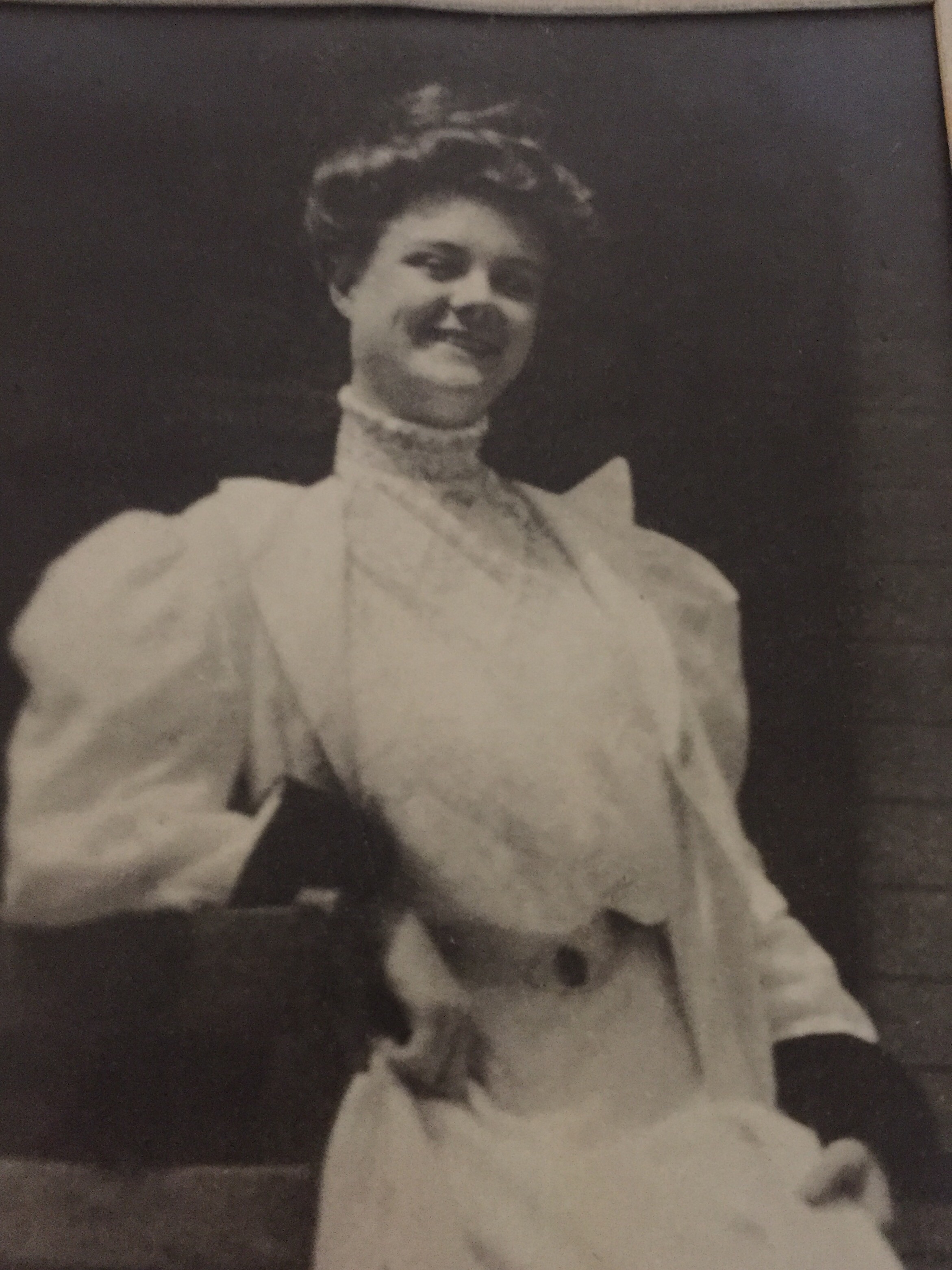
My grandmother, Frances Bickers Mattingly, circa 1908.

My grandmother Mattingly was a lovely woman, as you can see here. She died, pregnant with her fourth child, at age thirty. Unlike COVID19, the 1918 pandemic killed mostly strong young adults. Though I never knew her, I miss my grandmother somehow, and always have. With all this idle time on my hands, I miss my father, and especially my mother, during this, her birth week. The less we’re occupied, the more strong emotions rise to the surface I suppose. And though it seems wrong, selfish to speak it, I miss getting together with friends. I miss eating out and going to movies and plays and damn it, it’s spring. Of all entertainments, I miss baseball the most.

We–that is those fortunate enough to have so far avoided the virus–have lost something we desperately need: camaraderie, breaks to the routine. But I have what Mom left me, a love of books to help pass the shut-in hours. And I’m most grateful.


BOOKS
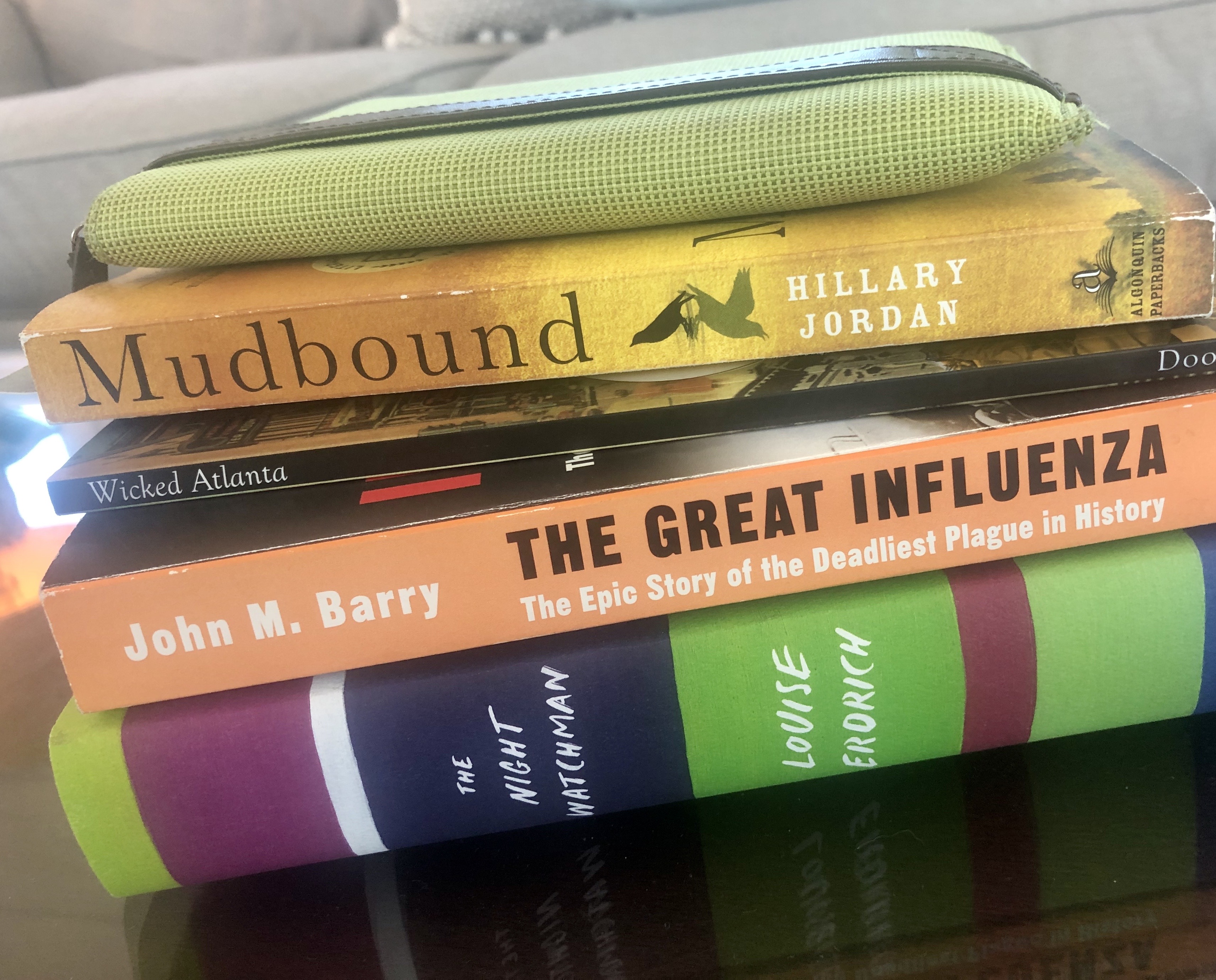
My current bookshelf

Centennial

All week, I’ve been noodling over a proper way to honor my mother on this March 21, 2019, the day she would have turned 100. I hate to repeat myself, or post photos I’ve likely used before, just because for my family this is a noteworthy day. But it does seem significant, the centennial. When early this morning, before my second cup, my daughter launched a group family text from New York, I thought, hmmm, she nailed it, and with little more than a string of emojis. Who needs words? Emma gives a crisp and warm tribute to “Joe,” the grandmother she respected and adored. 

IMG_1945

Then again … for those who still love words the way Joe did, perhaps a brief concordance is in order: Not exactly an angel in life, my mother, a devout Roman Catholic, certainly wears the loveliest of halos now, in one form or another. A woman worthy of swirling hearts? Absolutely. A charmer who loved to dance to the likes of Glenn Miller, she had her share of romances and enjoyed them every one, but once she settled down (at 22 no less), she was a loyal and caring partner to my father for 63 years. A superstar? Yes, Joe was, if a quiet one, as the characters that follow the star aptly suggest. Flowers … give her an old cut glass vase and she could bring out the best in simple back yard blooms. And, ah the little blue dress. Had she lived in another time or birthed fewer children (i.e. me), my mother had a shot at being the next Dior. Her sewing machine was her creative outlet and her family’s delight, as my sister and I and Emma herself can attest. At 81, Mom created for her a flower girl dress to wear in my nephew’s wedding that was elegant and sweet, just the thing for a six-year-old .

image
My mother at nineteen, duly admired by some of her beaus.

Next a crown … Was Mom the Princess to my father’s Prince? Indeed she was, bejeweled and beloved. And of course she became an old woman, a grandmother. If not doting, she was affectionate, full of pride and love for her twenty-five grandchildren and great-grandchildren. Still, my mother did not go gentle into that good night. I honestly don’t think she ever thought of herself as elderly, and though her stubborn resistance to things like wheelchairs and retirement homes brought her unnecessary heartache and her family endless frustration, maybe her stolid resistance to accepting the concessions of age was what kept her young-ish for so long.  

A wearer of Easter hats, and yes, addicted to black coffee. A better piano player than she gave herself credit for, she was an admirable consumer of wine if not a connoisseur and a great fan of gifts, both received and given (accompanied by makeshift cards, always signed with love). Shopping! Boy did she love a good bargain, but the coup de gras of my daughter’s emoji-esque tribute? It has to be the stack of pancakes. A half-hearted cook otherwise, my mother made a damn good pancake, so light and fluffy we generally ate a few more than was advisable. Well into her nineties, she continued to host her in-town family for Saturday morning breakfast. Even on days she burned the bacon and stirred cornmeal into the batter when she meant to use flour, we wolfed it all down.


A couple of emojis I might add to my daughter’s thread … the jet plane, and the stack of books. A wannabe travel agent and a devotee of museums, ancient cathedrals, lush English gardens and French chateaux alike, my mother taught me that travel is the best learning tool we have, with reading a close second. She devoured books, and collected everything from Henry Kissinger’s memoirs to Virginia Woolf’s novels. For that legacy, with apologies to Marie Kondo, I am most grateful. 

My Stats page tells me this is my thirtieth post in the Attic, thirty in about four years, though apparently I’ve shared nothing since last March. Maybe that’s a sign. Maybe it’s time to wrap it up. Lord knows (and as this post surely proves) I have repeated myself, circled around the same themes often enough. I won’t archive the site just yet, but I’m at work on a few other projects now. With luck, I’ll be able to share these one way or another before too long.

Those handy Stats also tell me upwards to six thousand folks have been kind enough to visit the Attic over its lifetime. They–you–have given my posts over ten thousand views. Thank you. Thank you for stopping by. Thank you for sharing the strangeness and laughter and joy and sorrow that come in the wake of losing a parent, no matter how old or young.

Happy 100th, Mom, our one and only.


To Know A Mother

img_0552
My mother with her youngest grandchild, who happens to be my youngest son, in 2010.

Now that our nest has emptied, I have more time to think, especially during the unfamiliar quiet of morning. Gone are the frantic searches for blazers and ties on dress-up days, gone the burned toaster waffles and spilt milk, gone the forgotten permission slips. So I sit with my coffee and watch the sky brighten outside the window. I check the weather in all the places where my scattered children live. I read the news (too much news, and immediately regret it). I scan social media, pour another cup, play a few words on WWF, maybe do the Times Mini Crossword. I mean to write more, every day (you’ve got all this time now, finish that damn novel!), but thus far, the muse remains fickle and slow.

Today I woke determined. My nerves sparking with caffeine, I trained my index finger over to the Poetry app I installed, oh three years ago, thinking to read a poem a day for inspiration. (Total number read to date = five) Clinging to the idea that it’s never too late, I chose a theme, “Passion and Nature,” and waited to see what the Poetry algorithm would find. Never mind that by “passion” I meant fevered devotion to a craft, the app figured romance (…er eroticism). Still, a piece called “The Garden by Moonlight” caught my eye. Ignoring the sexual undertones, I lapped up Amy Lowell’s lyric imagery and the cadence of her simple sentences: A black cat among roses … Phlox, lilac-misted under a first-quarter moon … The sweet smells of heliotrope and night-scented stock … Moon-spikes shafting through the snow ball bush …

I thought of my mother, and the cut flower bouquets she had such a knack for, the postcards she used to send from gardens around the world, the places she took me as a child: Kew, the conservatory at Golden Gate Park, Monet’s gardens at Giverny (I know, lucky me). I read on to Lowell’s final quatrain in which–what a wonder!–the narrator speaks of her own mother: Ah, Beloved, do you see those orange lilies?/They knew my mother/But who belonging to me will they know/When I am gone?

img_4927
My father and I, circa 1976, somewhere in a British garden.

A ping and there’s an email from my sister, reaching out to my brothers and me on the anniversary of Mom’s death. Yep, it’s October 19. My mother has been gone three years exactly. Next Wednesday marks the day my father, whose birthday we remembered October 9th, died fourteen years ago. As I’ve written here before, October has become a month of emotional contradiction for our family, and 2017 has not disappointed. While I was dashing between a big birthday bash for a dear friend and my niece’s wedding in Philadelphia (which morphed happily into something of a family reunion), our second son’s longtime girlfriend, a young woman our family cherishes as one of our own, lost her mother. She was hardly into her fifties, as brave in standing up to the terminal brain cancer she lived with for eight years as she was determined to be present for her children as long as she could.

So mother-loss has been on my mind for lots of reasons. Of course, losing a mother at fifty-four as I did hardly seems worth mentioning compared with losing a mother at twenty-five. And yet what the heart registers, what we share no matter when such a loss comes, is a sort of sorrowful disorientation. How do we step forward without the person who so often, for better or worse, has blazed the path we follow?

The thing is, the beating hearts our mothers gave us are built for more than sorrow. Much more. Along with conflicting feelings, they hoard images, words, memory after memory of the people who move in and out of our lives. Maybe what the poet Lowell implies with her black cat and her moonlit poppies then is something simple, something I know but have to keep re-learning: As long as we take time to share these heart-borne images and memories, to repeat them and pass them along, whether through the written word or music or painting or just plain storytelling over a good meal, we give new life to those we’ve lost.

A few years ago, my daughter and I visited Giverny together. Not unlike Lowell’s lilies, the cascading wisteria, the rows and rows of forsythia and zinnias bursting gold and red against the Monet-blue sky, they knew my mother, who made sure they know me. And now, they know my daughter, too.


Mother, May I? A Wish List on the Occasion of the 98th Birthday

Mom's 93rd
My mother turns 93, flanked by her favorite things: fresh flowers, a glass of Chard, a granddaughter, and, of course, her purse.
Continue reading “Mother, May I? A Wish List on the Occasion of the 98th Birthday”

The Power of Stuff … or Here’s to You, Elisabeth

Attic Fans: I’m honored to welcome Laura Schalk as my first guest blogger. I like to think of Laura, a lifelong bookworm raised in Poughkeepsie who now lives and works abroad, as my very own American in Paris. We met a decade ago at a writers’ workshop held not far from Hemingway’s old haunts on the Left Bank. Thanks to the bottomless generosity of one of our workshop members, we and six others from that initial group have continued to gather each summer to work, study, write, eat and laugh together in Bordeaux. (And the local grape, we enjoy a bit of that, too.) Despite the miles that separate us, we have become the best of friends. 

Like me, Laura lost her mother a few years ago. Like my mother, Elisabeth Schalk was a discerning reader who had a flair for fashion and a tendency to hold tight to what she loved, be it a shiny pair of patent heels, a box full of paperbacks, or her beloved family. Laura’s tribute to her mother here is graceful and true.  I hope you enjoy reading it as much as I have. And by the way, Laura writes insightfully hilarious short fiction, too. Be sure to check it out through the Amazon link that follows …


laura-and-mom-and-gramma-with-peter
With my mother and her mother, and my brother Peter behind, circa 1970. I still have Mom’s Icelandic sweater. Much to my regret, the groovy shades have vanished.

Martha and I have chatted many times over the years about our mothers: when they were alive and when they were dying, and later as we were coping with their deaths and with the resulting need to plow through the detritus of a beloved and fashionable woman’s years on the planet. Across two continents, we’ve shared the attendant emotions which that particular and at times painful task has stirred up – laughter through the tears and all that jazz.

When I read the first installment of “My Mother’s Attic,” I was jerked through space and time from sitting in a chair in my living room in Paris, to sitting on the floor of my parents’ bedroom in Poughkeepsie, New York, heartsick and hot and dusty. My mom was still alive then but in a nursing home, and far gone with Alzheimer’s. My dad had decided to put the family house up for sale, and I had flown back from France to spend three days going through Mom’s stuff.

Although this had taken place several years before, as I read Martha’s blog post, suddenly there I was on my parents’ bedroom floor again, pulling pair after pair of black size eleven shoes out of the cupboards that lined the baseboard. Black flats, black sandals, black loafers, black half boots – dozens and dozens of pairs, all stretched and worked and bearing the marks of Mom’s dear feet, some emitting puffs of dust and others disgorging dead flies or hornets. (At the Lutheran Care Center, my mother and the other residents on her ward wore white sneakers with Velcro closings, though very few of them walked at all.)

While I worked, my dad holed up in his study downstairs and left me to it. My equipment: a box of extra large black Hefty garbage bags, a marker, post-its, tape. After tossing most of those damn shoes, I dove into closets and drawers full of my mother’s clothes. One of the tics of Alzheimer’s is that people tend to re-buy the same thing, and Mom was no exception. I found stacks of barely worn pastel Eileen Fisher dresses, identical black “agnes b” separates, and bushels of handbags. I shared out a dozen pair of black leather gloves amongst my girlfriends, and returned home with twenty purse-sized bottles of Purell. Dad and I made multiple trips to the Salvation Army in downtown Poughkeepsie, unloading our flotilla of garbage bags from the back seat and trunk. To cheer each other up, we told ourselves that women from the area who were looking for jobs would find their happiness and good luck in interview outfits, courtesy of Mom.

20170122_125029
Mom was an avid reader throughout her life. Here are a few of her best old books, one with her inscription.

Each day during this seemingly endless process, I cooked elaborate meals – magret de canard, frisée salad with lardons, crab salad tucked into beefsteak tomatoes, the mayonnaise homemade. Dad and I brought out the good china and silver and crystal (including glasses Mom never let us use) for both lunch and dinner. Between bouts of cooking and sorting, I meandered through the house putting post-its on chairs, paintings, a desk, that read, “Laura – Paris.” At the time, this seemed a momentous and never ending task and I struggled to see the point of shipping all that stuff home.

And yet, as I prepared the other weekend for a dinner party, I set the table in my flat on Rue de la Chine with my parents’ wedding silver. I put tapers in some candlesticks that used to grace the dining room table of my youth. I didn’t serve my friends anything as refined as the meals Mom would spend a day preparing (Julia Child’s coq au vin, lemon-lime soufflé), but I felt joyful carving my basic roast chicken on a lovely old Willowware china platter. And when my friend Nadia had a recent dinner party of her own, I brought a few things along … we ate Berber chickpea stew (a recipe from Nadia’s mum), served on my parents’ pink linen placemats with matching napkins. I’m sure my mother, ever the expert and gracious hostess, would smile to see her old treasures being used in other’s homes, and used again.

It may be reductive and even ridiculous to state that my mother is dead but lives on through her wool coat, her books, or the much-mended eight foot long white linen tablecloth she rescued from the dissolution of her own parents’ home. But still, to this day I can’t leave the house without wearing or taking along some item of Mom’s: a ring, a bracelet, a slippery Hermes scarf that I never can tie with her Seven Sisters’ insouciance. And when some months ago, the chain to one of Mom’s necklaces broke as I was getting dressed and the pendant dropped to the floor and rolled from sight, I wept. I crawled around on all fours searching until, already late to my meeting, I had no choice but to give up. I shoved one of her rings on my finger, reapplied mascara and left the flat.

As time passes, I continue to muse about the lingering power of objects that have been owned, held, chosen, worn by our loved ones. Is it unhealthy, superstitious to confer such mojo on material things? Perhaps. Probably. And yet, in amongst the clutter my mother left behind, there were multiple potent talismans, enough to buoy her daughter, to propel her through the days ahead.

POSTSCRIPT: As I prepped for the Women’s March in Paris last week, I was sure to wear the t-shirt my father gave me years ago, one which sadly is now more relevant than ever, and says, “Women’s rights are human rights! Stop the Republican war on women!” But I also gave full reign to my mania for talismans and wore or carried a panoply of objects from beloved women and men in my life: bracelets, a necklace, earrings, a pin, a flask and Dop kit and a handkerchief. Before I headed out, I tucked a water bottle bearing photos of my nephews in my knapsack and slipped my mother’s wedding ring on my finger, a thick gold band whose inscription is still visible: “Amor vincit Omnia.”

–Laura Schalk                                                                                                                                        

Laura’s short fiction is anthologized in “That’s Paris: An Anthology of Life, Love, and Sarcasm in the City of Light” and “Christmas, Actually: A Holiday Collection.” You can find both at http://amzn.to/2jL4Oun.   

Have Faith, Will Travel

image
Who knows when you might need a good piece of hotel stationery? My mother’s collection dated to the seventies.
My mother spent her twenties and thirties (and thanks to me, her forties) changing diapers by day and going to PTA meetings by night. While my father went from WWII vet to laundromat owner and on to the life insurance business, she prettied up basement apartments and matchbox houses ’til they felt like home. But Dad thrived at Guardian Life, and by the time I reached double digits, Mom figured it was her turn, time to shake out her wings and fly, literally. Travel became her passion. I don’t mean quick jaunts to the Georgia coast or the Smoky Mountains, places my father, known to gaze upon a crashing waterfall for hours, loved. My mother didn’t mind an ocean breeze or the smell of woodsmoke now and then, but the older she got, the more she craved something a little higher brow–the French Quarter, Williamsburg, Gothic Cathedrals and castles on the Rhine, the Tuileries, and of course, Harrod’s and Le Bon Marché.


This slideshow requires JavaScript.

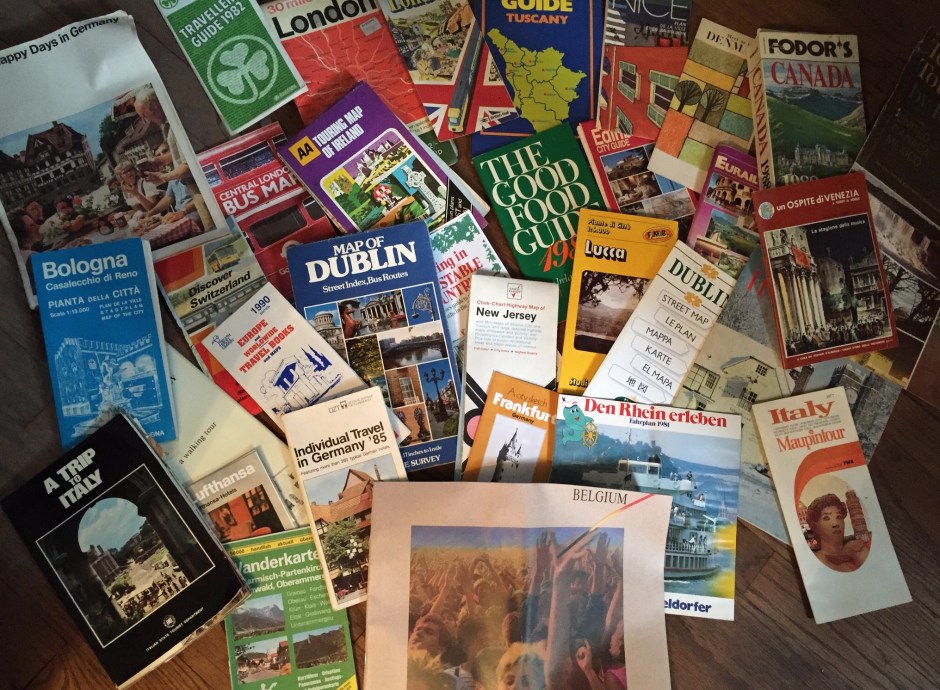
Who knew? The small town Florida girl, the markedly fertile eldest daughter of a Baptist dentist and his civic-minded wife (neither of whom ventured beyond the rolling hills of Virginia) pined for the Old World. In her fifties, my mother joined study groups led by Atlanta professors of history and literature and philosophy. She bought oversized maps and guidebooks (saved in the Attic, by the boxful). She thumbed through classics like A Moveable Feast and Dubliners at the public library. She concocted elaborate itineraries that she oft edited and revised, adding notes in red about what neighborhoods were frequented by which authors and which shoes to wear with what skirt to which restaurant. My father, hesitant but game, found the local Delta office and gathered birth certificates and with Passports and Travelers Checks in hand, my parents were off.

img_1907
My first trip to Paris, summer 1972. Since, I return often to find the little piece of my heart I left behind.
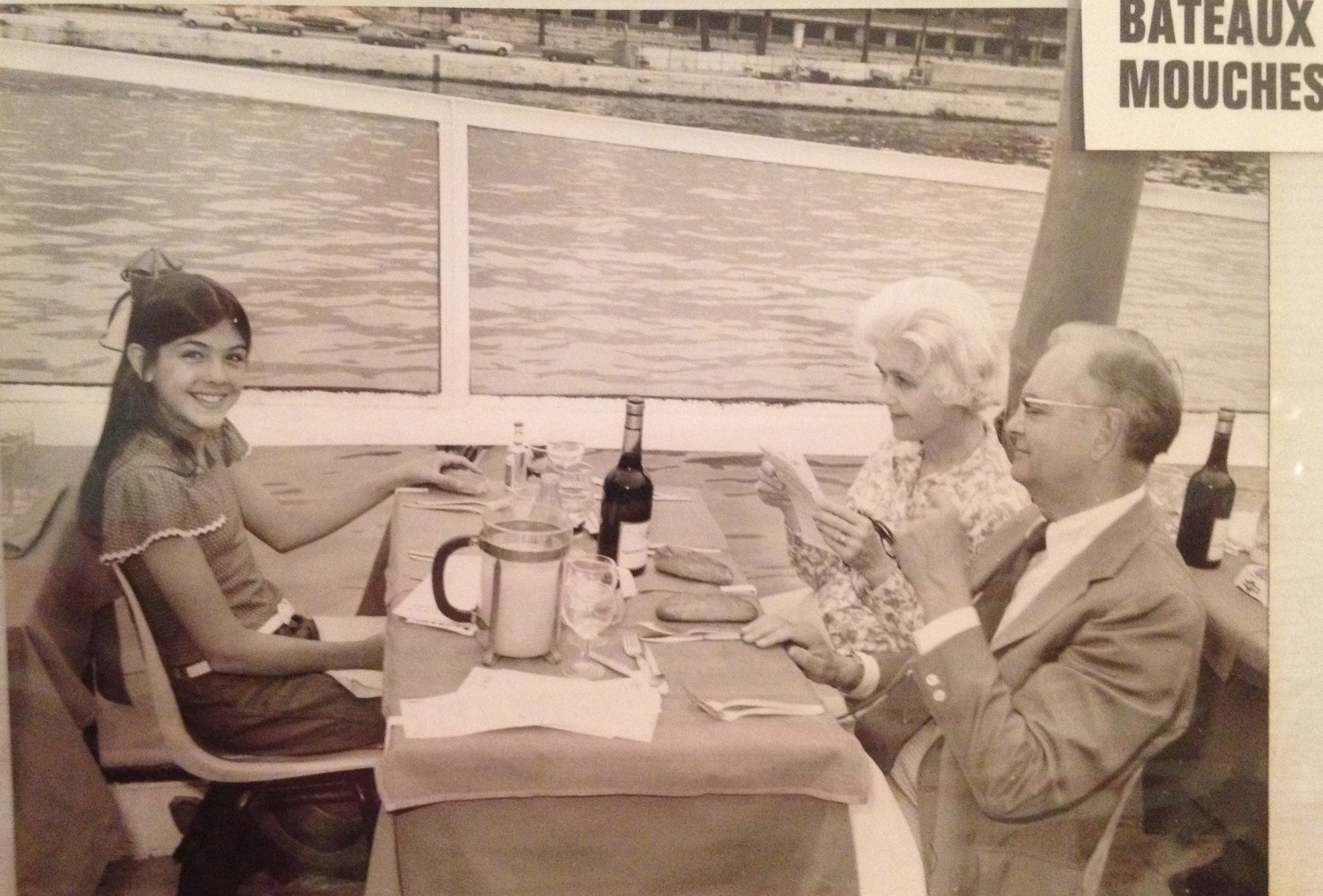
The only child still at home, I was invited along on some of these Grand Tours. Above, c’est moi at twelve, enjoying a baguette while cruising the Seine. It didn’t occur to me to be bored by the idea of spending a few weeks tagging along with my older parents. Well, not until I hit fifteen. My young heart swelled at the sight of Westminster Abbey and the Houses of Parliament shining in a chilly London fog, or the endless sumptuous rooms of Versailles rising above checkerboard gardens. My spine tingled to see the bones of the saints lying in dank crypts and the passion of Christ splashed out in the bright incongruous colors of stained glass and Italian triptychs. Believe me, I saw no shortage of stained glass and triptychs, also piétas and Virgins with Child and saintly frescoes on stone church walls. My parents, devout Roman Catholics, were a little biased toward the house of worship. We visited Romanesque and Byzantine and Renaissance, everything from the most ornate nave to the simplest country chapel. In fact, the first thing we did after unpacking our bags was to locate the nearest Catholic church, check the times for Sunday Mass, and plan the rest of our activities around them.

image
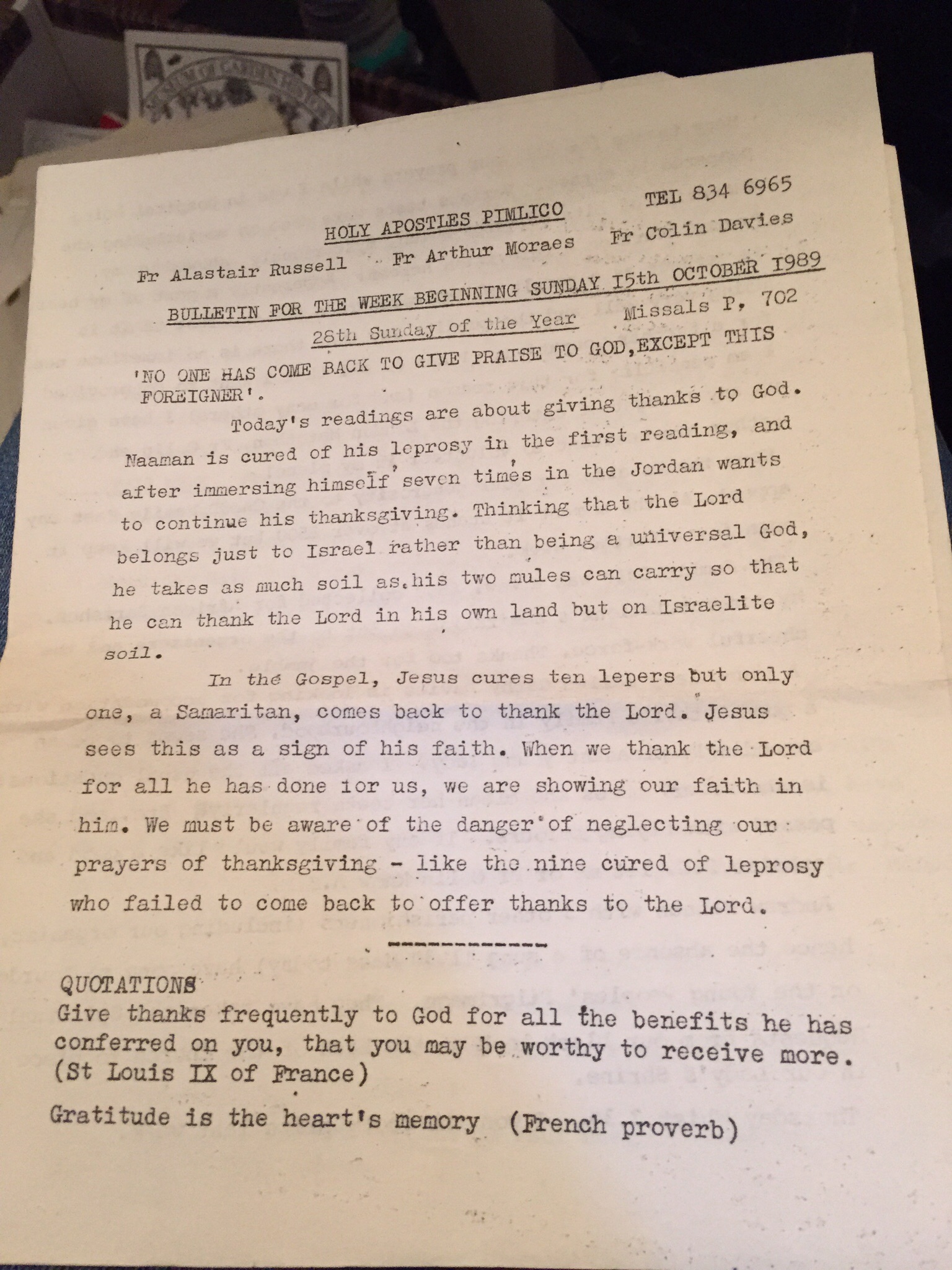
Sunday Bulletin from Holy Apostles Church in the Pimlico neighborhood of London, where my parents attended Mass in October of 1989
This went for domestic travel, too. Mom saved hundreds of dusty church bulletins from their Sunday visits over the years. I admit this was my least favorite part of our journeys. Attending Mass weekly (and forget not holy days!) at home was trying enough. None of my friends (Protestant, most of them) had to go to church on vacation, especially if it meant sitting on a wooden pew sans cushion while a priest wafted myrrh and offered the Communion Prayer in German, or French, or God forbid, Latin. Honestly, what’s a vacation if not a means of escape from life’s ordinary duties? But go along I did and here’s the thing. It hath marked me. All these years later and fallen away Catholic that I am, I can’t resist a good musky cathedral when I see one.

In a few weeks, I have reason to drive from Seattle to Atlanta. It’s a trip I both dread and look forward to. Forty-something hours in the car across country I’ve only heard tell of–Idaho, Utah, Arizona, New Mexico, and Texas. My daughter will join me a couple days in and we’ve decided to take the southern route. Emma is good with a camera and I’d like to try my hand at travel writing so we plan to document our journey, here, in My Mother’s Attic. My father loved the sort of dramatic scenery we’ll encounter, canyons and long vistas and rushing waters. My mother? Less so. Long drives and roadside motels weren’t exactly her thing. Since these are her pages, I keep thinking we need a theme for our trip, something to make our journey Attic-worthy, some pursuit that would have made Mom sit up and say, “Sure, strap me in and hit the gas!”

IMG_2627
A box of treasures from my father’s dresser drawer. Closest to his heart? His alma mater, Georgia Tech, Father Time, and of course, The Church.
Churches! We’ll pass through areas settled by Spanish missionaries, si? So between stops at river gorges and ghost towns and desert oases, Emma and I will keep an eye out for them, for churches and temples historic and plain, maybe a few that are a little strange. And when we find one, we’ll share it in this blog. When you think about it, writing is akin to hanging on to letters and photographs, boarding passes and admission tickets and pamphlets. Maybe Mom’s instincts were okay (is admirable a stretch?) Hoarding helped her to hold close, later to share, the joy she felt in real time as she sat on that plane to Munich, or strolled through the Louvre, or attended Mass at St. Mark’s in Venice. She and my father had landed themselves in places exotic and holy, places she’d only dreamed of during those long lean years of child rearing. Who could blame her for making each moment a keepsake?

If any of you reading today hail from the American West, shout out your favorite tourist attraction, especially if there’s a house of worship in the vicinity. And see ya in a couple of weeks, from parts unknown!

I Am Mae Mobley

My birthday is in July. Mid-summer, any way you slice it, prone to the lingering 4th hangover and hot and gluey the hemisphere around. In Atlanta, my home town, July 8th often dawns drowsy and nondescript, a day when traffic is strangely light and folks wind up sipping icy beverages by the pool or streaming baseball in front of an AC vent. I mean, think about it … has anything of true significance ever happened on July 8th? I looked it up, and–not much. In 1835, the Liberty Bell cracked, though reports vary. It might have been the 12th. In 1907, whoop-dee-doo, Ziegfield opened his first follies in New York City. 1918: Hemingway was wounded on the Austro-Italian front but macho-man that he was, survived to pen his oeuvre. 1947: a UFO crashed down in New Mexico (or not), and in 1949, Wolfgang Puck was born, followed by Kevin Bacon in ’58. Hmmm.

To be honest, I used to feel a little sorry for myself for having my special day during this time of scatter, a summer limbo void of classroom cupcakes and piñatas. When I was a wee thing, my birthday parties tended to be poorly attended at best, fleshed out with persons my mother rounded up to stand in for my wider circle of friends, who were off at camp or beach-combing with their families. Nowadays, I often vamoose on July 8th myself, and really, as the calendar turns, what could be better than to flit out of town and have one’s birthday forgotten altogether?

But in July of 2016, I was home in the city. My birth-week went haywire from the start. On Tuesday the 5th, Alton Sterling was shot by police in Baton Rouge, another possible case of color-coded fear having led to the panicked and deadly misuse of power. Ditto on the 6th, when a routine traffic stop in suburban St. Paul ended with Philando Castile, an African American man, dead. Yet sadly, if not for what happened next, on my birthday eve, these events might have become little more than tragic footnotes in the on-line version of “On This Day in History.”

As yet unaware, I woke on the 8th to the joy of family texts and emails sent at the crack of dawn and a birthday poster lovingly drawn by my youngest son. But before I could pour my first cup of Joe, I found myself longing for the dull birthday anonymity I used to lament. On the kitchen television, an endless loop of chaos and gunfire on the streets of Dallas during an otherwise peaceful protest, a dozen policemen sniper-shot, five dead.

Mass shooting number 150 or so on the year, and we were hardly halfway home. I don’t know how many of these were racially motivated, but I’d bet a silver dollar they were all rooted in hate, the kind of hate that when kindled by emotional instability is likely to fester in the heart of the dispossessed, the kind of hate that so often meets with an ironic end, where one desperate individual lashes out against others equally marginalized, but for different reasons, the kind of hate I believe is at its core self-hate, and in the end bound to turn on itself, but only after havoc has been wreaked. Consider the deeply troubled and alienated white drug addict who guns down African Americans in Charleston, in a place of worship historically vital to the Civil Rights movement; the pathologically angry Muslim American, isolated within the country of his birth, who opens fire on his gay neighbors; the mentally disturbed black war vet who ambushes white police officers as they monitor citizens of varied races seeking to prevent future incidents of policing gone sour.

Woman and Child
September, 1966, a race riot rocks the streets of Atlanta’s Summerville neighborhood. Here, a young mother clutches her young son, rescued by a white police officer from her tear-gassed home. Layer upon complex layer of anguished love.

I’m over-simplifying, and even so, my head was spinning. The line between villain and victim grows more muddied every day as hot-button issues like gun legislation, immigration, mental health care, police brutality become so multi-layered and complicated it’s impossible to discuss them without simplifying. But enough. I don’t write today to enter a particular dialogue. I write because as a white woman born and raised and still living in the American South, my bones ache with a helpless sorrow I can’t well reckon with. I write in the hope that putting words to paper will help me lasso emotions I can’t otherwise make sense of. And already I’ve erred. Sorrow isn’t the right word. What I feel is closer to despair. That we as Americans, no matter the shade of our skin, continue to wrestle with the violent manifestations of the same brand of hate, the same demons that have threatened our nation since its inception, is unthinkable.

On a long flight home that summer of 2016, I flipped through Delta’s offerings and came across The Help. I’d seen it before, and on both occasions found it more moving, more true-to-life than I expected (I boycotted the book, perhaps unfairly, having heard it was sappy and overdone). What I’d forgotten was the uncomfortable blend of warm recognition and biting shame the film dredged up in me. In some ways, I am Mae Mobley Leefolt, the little white girl loved and cared for by Aibileen Clark, the Black woman the Leefolts referred to as their maid. Mae Mobley was born, fictionally speaking, in August, 1960, in Jackson, Mississippi. I was born in July, 1960, in Atlanta. Mae Mobley had Aibileen. I had Mary Darian, the young woman who worked at our house not every day but often enough I thought of her as family. When in the final scene Mae Mobley calls out to Aibileen, “You’re my real mother!” (yep, pretty sappy), my heart leapt in spite of itself. Though my mother wasn’t negligent like Mae Mobley’s, Mary was sort of her co-mother, an energetic, funny, hands-on, more hip role model than Mom, forty-one when I came along, was capable of being.

And Mary was Black.  And far too smart, too gifted, for her position. She had small children of her own someone else cared for while she raised us, no doubt earning less than she deserved. Yet she changed my diapers and sang me to sleep. She picked me up from school and brought my dog along to greet me. She fried a chicken for us on Friday afternoons. Later, she wrote me at camp when I was homesick, sharing details about what my brothers were up to (“Tommy and I cleaned out his closet. He hates making decisions”), complimenting my mother’s sewing projects or cracking a little joke, usually at her own expense. Sometimes she signed off, tongue-in-cheek, “The Maid.” My favorite letter (from Mom’s Attic, of course) is written on two sheets of construction paper torn crookedly across the top and quadri-folded to fit the envelope. After dating the letter, Mary wrote “cheap paper” in parentheses and a few lines later elaborated: “This paper is slightly uneven–like the writer.”

image
My Crazy Maid Mary, so dubbed in an essay of the same title, one in which I sang Mary’s praises to my fourth grade teacher. I’ve searched and searched, but the Attic has yet to produce that particular heirloom. Here, she meets one of my nephews.

Mary left us when I began junior high, taking a job at the hospital where I was born. Mary made a career there, earned a few promotions and stayed on for twenty years. We kept in touch, a phone call now and then, quick visits during family weddings, funerals. Then, a long gap of time passed with little contact until the day of my mother’s funeral. As I walked out on my brother’s arm, I caught sight of Mary at the end of a pew. White-haired, a little stooped, she somehow wept and smiled at once. I stopped, and we hugged each other’s necks and cried together. She told me how much she’d loved my mother, her friend, how she misses me, and all the Mattinglys.

During the weeks after the violence of summer 2016, I thought a lot about Mary, then eighty, and felt that same warmth tempered by shame that movies like The Help can rustle up. I like to think our bond was unusual, deeper than most of its type. Mary was my friend and yet, history says what we and thousands of other Black-white, housekeeper-child duos of the fifties and sixties shared was tainted. History says that if not for the evils of slavery, these bonds wouldn’t exist, that perhaps they shouldn’t have existed. I can’t deny the truth in this, but then, what do we do with the warmth, the love, that remain?

It occurred to me that other than what I share here, I didn’t know Mary Darian’s story. I didn’t know how she, eighteen when my parents hired her, managed to break the cycle of domestic service. I knew nothing, as her white baby of the 1960s, about the sit-ins and marches, the tear-gas and beatings, that were happening across town, maybe in her neighborhood. I didn’t know who or what she might have lost to the long slog of the Civil Rights struggle. My parents, like Mary herself, were determined to shield me from these seminal, sometimes violent events that would shape our lives. In this, my ignorance of Mary’s story, lies a valid basis for guilt and shame. I can’t change history. I can’t make amends for actions taken by my forebears, though I regret and renounce them. I can’t go back and rearrange the circumstances of my relationship with Mary, but that summer I realized I could at least do what another one of Kathryn Stockett’s characters, Skeeter, does. I could learn Mary’s story. I owed her, and myself, that much.

Late that July, I dug up one of my mother’s old address books and skimmed a few pages in. There it was, between Coleman and Davis: Mary Darian. Unlike other entries, it was not written in my mother’s script. Mary had jotted in her name and address herself—of course she had—in the same big beautiful hand I’d thrilled to see in letters she wrote to homesick me at camp. Mary’s entry, unlike others, was neither scratched through nor updated. Maybe, I thought, she still lived in that tidy house I’d visited. Maybe she had the same landline my mother used to dial up whenever she missed the woman she thought of as much more than the help.

There was only one way to find out. I pushed the home button on my cell phone, and made the call.


If you’d like to read more about my journey with Mary, click here to access “Afternoons with Mary,” the sequel to this post. Many thanks for reading!

Generation Sandwich

“How’s your mum?” asks the sunny checkout woman.

My heart does a loop-de-loop. Hanging in there, I almost say, a grapefruit in one hand and a pack of sponges in the other. For so long, this was my stock response to this stock question from this kind-eyed Pakistani woman with the sprawling memory. This isn’t my usual grocery. Close enough to my house, it’s closer to my mother’s, or to the house that was my mother’s, and my father’s, mine, for half a century. In the years after we took away Mom’s keys and before her get-up-and-go got-up-and-went, we did her shopping here.

“Oh, she passed away,” I manage, cheeks flushing with heat as I do a quick calculation in my head. “Um, a year—no fifteen months now.” Can she have been gone that long? And why this need to pin it down, to date her death for a stranger?

“So sweet,” the woman says, her soft features sagging. “Your mum … such a sweet lady.”

6-28-2009_015
In my mother’s sandwich days, she sometimes included my grandmother on family trips to Fernandina Beach, Florida. Here, with my sister, she glows.

With this, she gives a wan smile and we all grin and nod like eager Labradors, even my daughter. Yes, my daughter is there at the far end of the cart, home from college for the holidays. Leaning in for the dish detergent, she smiles broadly for the checkout woman then glances at me. They were close, Emma and my mother. They shared a love of fashion, things that sparkle, a petite stature. She misses her grandmother, her “Joe,” but there’s more. Already, at twenty-one, Emma’s smooth pearly skin gives off a curious vibe, a blend of sorrow and unease I’m all too familiar with. She’s as concerned about me in this awkward moment as she is mourning our shared loss.

I finger the sugar snaps in their crackly bag, straighten the box of microwave bacon on the belt because, well, who knows why. When on the spot, I am an aligner, cutlery on a spread table, the floor mat at the door, bacon on the belt.

“She shopped here?” asks the bag boy. “Your mother?”

Our rescuer! He’s young, Emma’s age, maybe younger, and a pleaser. I can see this in the easy way he puffs out my recyclable bags and hands in the heavy items first, the eggs on top, the meat in its own plastic.

“She did,” I say. “All her life! She was ninety-five …”

“Oh yes!” The checkout woman, keying in the zucchini. “She shopped here each week …”

She sweeps a hand in the direction of the produce, the condiments aisle, the canned goods. A knot has risen at the base of my neck. Enough, I think, but still I track the woman’s wave and who is that, just there? A small bent white-haired figure struggles to read the label on a jar of jam. She fumbles for her glasses, shakes her head, purses her lips. Something is not right and she reaches, a tremor in her hand, to reshelve the jar. It doesn’t fit. Where is that patch of free space she pulled it from? With a sigh, she drops it in her buggy anyway then scans the shelves again, squints at the creased scrap of a list between her gnarled fingers.

Marmalade. Maybe if I think it hard enough, she will remember … It’s the orange marmalade you want, the one with the red gingham cinched over the lid.

“Oh, how I remember her …” The checkout woman again, on a roll. “She walked like this …”

The bag boy pauses, his chin tilted up with interest, a pound of sugar balanced in one hand. We watch as the woman drops her arms to her sides and shuffles her feet—my mother’s signature walk in her last fretful years. Like a penguin, my young grandnephew once said, nailing it. The woman flicks her eyes at me and quickly away—has she gone too far? Yes, and no. Emma smiles again, not so broadly. I follow her lead. After all, how often have I mimicked the penguin walk myself, in Mom’s presence and otherwise? We only tease the ones we love …

“I used to help her outside, to wait.” The woman can’t be stopped. She meets my gaze, her eyes less kind. In her household no doubt, the elderly are revered.

“To wait for you,” she continues, gesturing again, through the plate glass window . “On the bench.”

The bag boy glances over his shoulder, past the Lotto machine and the ice cooler to the empty bench on the far side of the glass. It’s true, on very busy days I sometimes dropped Mom to do her shopping alone while I scooted off on some other errand, to pick up a child from baseball or gym practice, maybe to grab a cappuccino. There were times Mom had to wait on me. She didn’t mind, usually. In fact, she liked it! I expect I can do my own shopping … she would say with a toss of her head. She needed it, my mother, this small dose of independence.

Andshe was not ninety-five then! I want to cry it out. She was late eighties, maybe ninety-one at the most! Boy, does my head hurt.

“Ninety-five!” the bagboy exclaims. He too meets my gaze, yet with nothing but good cheer. “What a life. I’d take that any day.”

I grin fiercely, more Pit Bull now than Lab.

“Yes,” Emma says. “Ninety-five!” She settles a bag, then another, into our cart. I swipe my card, say my thank you’s, and we turn to go.

“She was nice,” Emma says on our way to the car. “That lady. She must have really liked Joe.”

“Yes, she’s worked there a long time. I used to …”

“I know, Mom. You did everything for Joe.”

She doesn’t mention the bench, or the penguin shuffle, or the fact that in those feverish wonderful days when she and her brothers lived at home and their widowed grandmother lived half a mile away, I may have let things slide a bit, that on those last visits to this grocery Joe might have been too rickety on her feet, too forgetful, to be left to her own devices. Emma doesn’t say that maybe Joe needed her daughter there to pull down the marmalade and help her out to the bench.

She doesn’t mention it, but like she says, she already knows.

IMG_0556
Our happy sandwich, May 2010.