Boys to Men

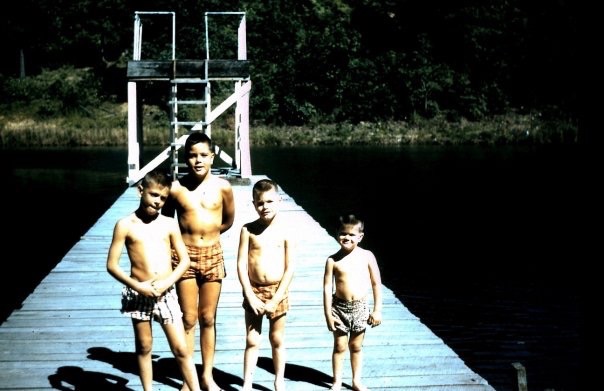
Fun at the Lake, the Mattingly Brothers, late 1950s
Fun at the Lake, the Mattingly Brothers, late 1950s. George, Ed, John, and Tom.

Growing up, my sister and I were bookends to a guy bookshelf, the girly bread on a sandwich four-boys thick. It made for a rowdy childhood, a household full of mischief, especially for my sister as the oldest. At right, my brothers are boys again, enjoying a warm summer day in the north Georgia mountains. Originally a slide, (one of thousands my oldest nephew has tirelessly digitized), this photo is straight out of Mom’s attic. Of all the grainy, dog-eared images I’ve sifted through lately, this is one of a few that nag at me, keep me clicking back, again and again.

Westminster Men's A Capella, 2015-16, at Tate Mountain, Georgia.
Westminster Men’s A Capella Retreat, 2015-16, at Tate Mountain, Georgia.

When a week or so ago the photo at left popped up on my Facebook feed, I pulled the old brothers’ pic up yet again. The dock and dive tower, the distance to the far shore, the reckless joy of a summer’s day on the water struck a familiar cord. I’m pretty sure the setting is the same. Now and then, our family tagged along when my uncle visited a friend’s summer home at Tate Mountain, Georgia. The dive tower has been rebuilt (though whether with safety or increased risk in mind is hard to say) without sacrificing the earthy primitive feel of this remote mountaintop retreat (It’s private, by the way, so don’t get any ideas).

This coincidence of place, though it got me thinking, isn’t really the point. It’s the fresh faces, the body language, the endlessly varied expressions of these young men–even the ones I hardly know–that grip me. In part, it’s something shared, some deep boyishness in their bearing that plucks my heartstrings. I think of my own sons, young men now but still boys to me. I think of my father, who loved lake and ocean and waterfall alike, and most of all, I think of my brothers, those four guys I idolized as I grew up (even when they were needling me, calling me disparaging names, and later, ordering me to the kitchen for beer and snacks to enrich their football afternoons).

I didn’t know them when they were as young as the first photo depicts, but I swear I get a glimpse of the men my brothers were to become. In Ed, the oldest, there’s a certain vulnerability, an eagerness to please. I see the hesitant but dutiful Marine he would one day become. Next, George the renegade, slouching, planning his next move as he sizes up the photographer with a skeptic’s eye. Then John, his hands crossed so sweetly, a little aloof, always thinking. Finally, Tom with his wily grin, the youngest but always his own man, witty and confident.

ROTC Ed with brothers, Marist School, Atlanta.
The brothers a little older. ROTC Ed at left. All students at the Marist School, Atlanta, the others would follow his lead.

Why do we cling so tightly to images, both recent and long past? Maybe because a moment caught in time can be just this full of possibility, studded with character clues, even hidden meaning, long after the subjects pictured have moved on or passed away. Maybe this lies behind our current compulsion to click and edit, post and share, zoom and enlarge. We have this need to document, leave something behind, even if we aren’t sure what will prove meaningful, even epic, and what will be trash. (Consider the tattered photos my one-eyed father snapped on his old Kodak. Mom kept those too. Family members are split down the middle or cut off at the neck; grand cathedrals bleed off the page while front and center is a nameless fire plug, an unidentified stretch of highway, or as shown below, a blank wall and tasteless curtain. Très post-modernist my father, and he never knew it.)

White Wall, with Son and Daughter, circa 1969.
White Wall, with Son and Daughter, circa 1969. Note Tom’s steely grip and the terror in my eyes.

Maybe I’m full of baloney! Maybe we just like to see ourselves, capture our requisite fifteen minutes (isn’t it more these days?) of limited fame so we can broadcast it to the cyber world. But I will say this. I’ve know some of the guys in the more recent Tate Mountain photo for years now, a few of them since they were kindergartners, and I get the same dizzying sense of deja vu when I see them here. There’s the kid who always made the moms laugh on the playground, just as playful now. And another, still gentle and wise and shy of his movie-star good looks, a third always cool, a little wary of what’s being asked of him. As for my youngest son–far left, second tier, blue trunks–I can’t quite put my finger on it, but something about his stance, that hand at rest on the railing, the muted smile, has been part of him since the day he was born.

I’ll close with a PS snapshot of my brothers with my sister and me. They don’t look that different, do they? I mean their expressions, their essence, shine through. And what a comfort it is to see that Ed, whom we lost eight years ago, kept that boyish smile, the warm heart it heralded, right down through the years.

Mattingly Siblings, 2005, Smithgall Woods.

Air It Out

hm-g4b

Greetings Attic Fans! Pardon the pun but hey, who remembers the Attic Fan? There’s one in My Mother’s Attic, a big clanking contraption whose business end was sheet-rocked over years ago. In better days, on the odd spring or autumn Saturday morning, my father liked to crank it up and let ‘er rip. To clarify—this was no portable window mount, not a fan meant to cool the attic itself but rather a six by six leviathan that lay prone (see diagram) on the attic floor, ready to suck the heat and dust up and out of the rooms below. It’s still around, this sort of fan, though it goes by a different name—the Whole House Fan, billed as a green homeowner option.

Well, ours was just the attic fan. When it fired up with its Blitzkrieg racket, my mother would flash me a wry smile. My father’s airing-out ritual was a tradition she didn’t see much sense in. Having grown up in Florida pre-air conditioning, she had her fill of oscillated air and dust cyclones long before she met Dad. But she went along. I can see her now, hair tucked beneath a scarf as she marched around opening windows in cotton blouse and khaki slacks and tiny white Keds (an outfit never-to-be worn outside the home). My father did the heavy work, which included reaching through cobwebs to right screens that had bent or slipped from their hinges during the long shut-in season.

The window screen was an essential in our house, a barrier both literal and figurative between the out of doors and the more orderly—and in my father’s mind, superior—indoor sanctuary. Much angst arose if on Attic Fan Day a screen was found to be broken beyond repair—think of the pests that might enter! Bringing the outdoors in was an alien concept for my parents. Their goal, a common one for their generation, was to celebrate all the many ways humankind had managed to conquer the natural world. Plus, outside was menace, or the gritty memory of it—a nation ravaged by the Depression, bled by war, threatened anew by the growth of frightening movements like Marxism, Feminism, Free Love, philosophies that baffled my parents–hadn’t they just fought a gruesome war to prove the virtues of democracy and the American Way?

Attic window-on-the-world

Thus did they join the flight to the suburbs, where inside the home, all was fresh and safe. And we stayed there. We had no front porch, nor back for that matter. No deck, certainly no outdoor kitchen, not even a grill, unless you count the rusted-out Weber on wheels my father rolled out of the garage once a year under pressure from my brothers to barbeque steaks. Don’t get me wrong, we had land, rather a lot for a property within Atlanta’s city limits—big shady hardwoods, tall pines, azaleas and dogwoods and even a gurgling creek, and my father maintained it all himself. Yardwork was his hobby, his exercise. It was all well and good to enjoy the outdoors, but when it was time to eat, or socialize, indoors was the thing, and we wouldn’t want a fly in our soup.

Still, we had our Attic Fan. Once the window screens were secured, Dad moved on to other Saturday projects—weed whacking, mowing the lawn, cleaning gutters. Meanwhile, mom and I floated about the breezy house, shouting above the din, pockets of air buoying us up the stairs and down the hall. The fan brought the house to life, curtains aflutter, sheets rippling as I made the bed, somewhere the tinkle of a wind chime. I remember feeling I could breathe more deeply, my lungs expanding, filling with the promise of the fresh new season ahead. When later my father came in to throw the off-switch, a sort of melancholy set in. I used to stand in the hall and gaze up as the big blades of the fan creaked to a halt. Then the blinds that hid it would snap shut and I had to wonder why. Why couldn’t we have this happy commotion always, this rush of air from somewhere beyond, somewhere exotic and pulsing with energy?

It’s funny, I planned to write today about travel, my mother’s way of seeking the exotic. I meant to apologize for having been away so long, and away I have been, to Thailand to visit an adventurous son. This, I thought, would make a nice segue to sifting through the boxes full of travel memorabilia my mother saved over the years. But somehow, the Attic Fan swept me into a different kind of journey, a journey inward. Thanks for joining me.

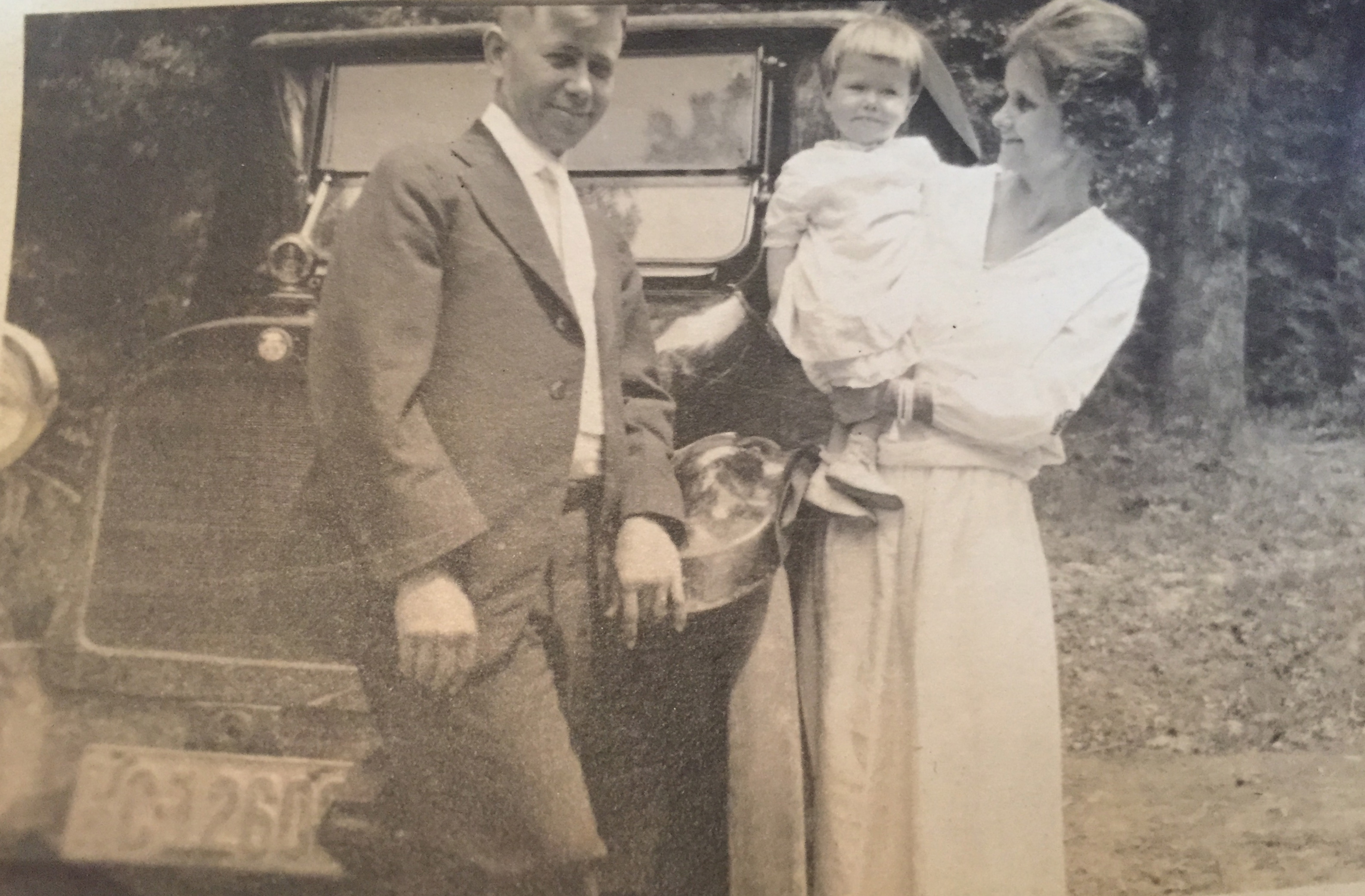
This Saturday, March 21st, would have been Mom’s 96th birthday. So I’ll leave you with a snapshot of her as a baby, the pride and joy of her dapper parents, another from her 95th birthday party. We worried such a celebration would be too much for her, but it was a great success. We fancied Mom up a little … pinned on a flower, dabbed on the rouge and lipstick she once wouldn’t leave the house without, and somebody came up with a birthday girl sash. Mom liked it, all of it, and she stuck around—indoors, mind you—much longer than we expected.

Happy Birthday, Mom. We sure miss you.

My mother, with her parents, at about a year old.
My mother, with my grandparents, circa 1920.
Birthday Girl
Birthday Girl, feted by grandchildren and great grands alike.

All Buttoned Up

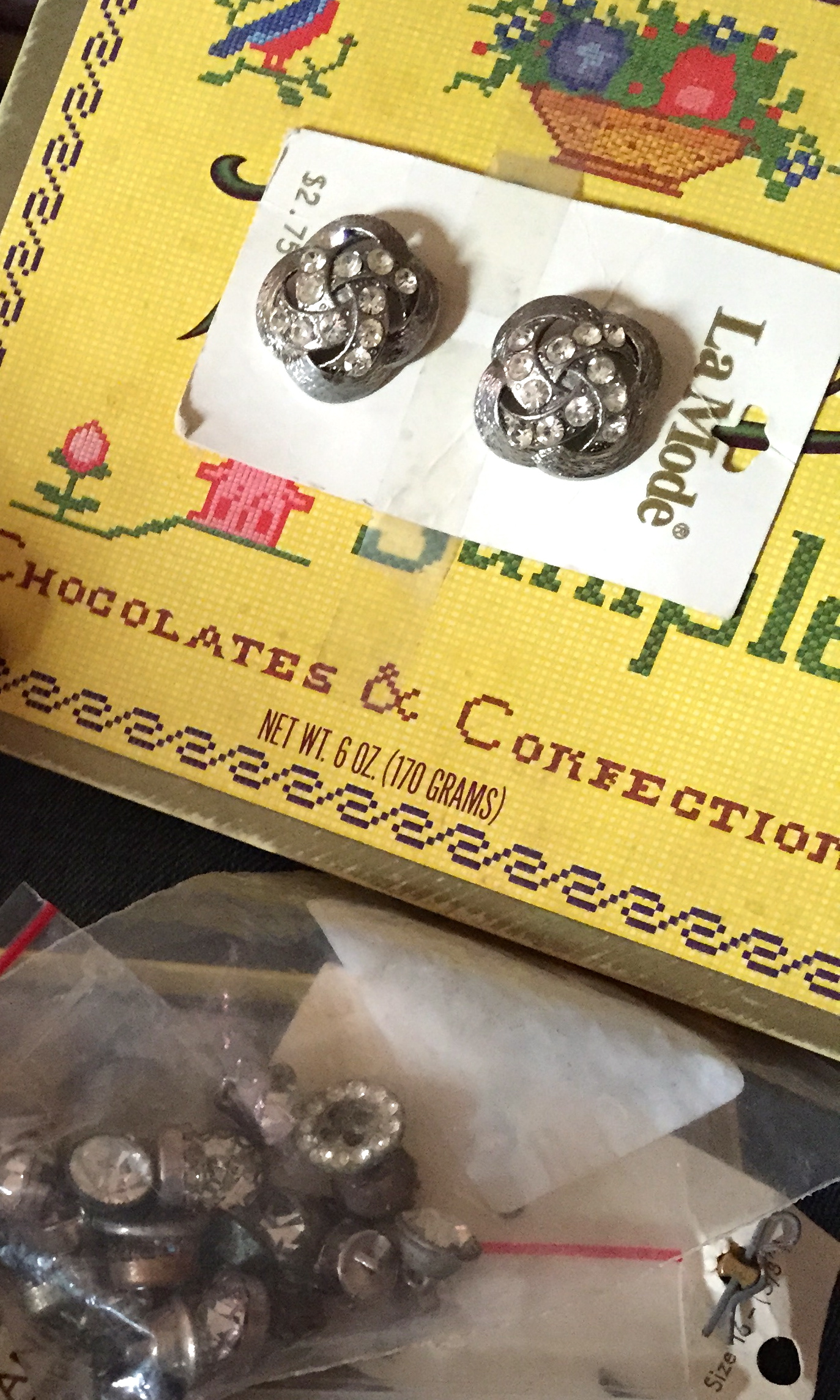
Button drawer There’s something pleasing about the button–simple yet functional, often bright, sometimes shiny, and usually a circle–sun, moon, wheel, life. So primal, and yet, somehow divine, and my mother had ‘em by the dozens! Before I wax on, a disclaimer—two entries in and already I’ve moseyed out of my mother’s attic (it’s cold up there!). Down the splintered stairs and up the drafty hallway I go to the sewing room, which began its life as my bedroom. Question—does it count as a bedroom if there’s no bathroom within ten yards? The baby of the family, I was two when my parents built their dream home, so naturally I got the bedroom that wasn’t. I figured it was normal to scuttle through a closet and hopscotch between highboy and hope chest to get to the potty. The house that has fallen silent now was crowded and chaotic then, four brothers, two of them teenagers, sharing a pair of bedrooms and a Jack ‘n Jill bath, plus my sister, who at eighteen wasn’t keen on the idea of sharing much of anything. Who could blame her? She’d survived childhood (including semi-annual, seven-hour station-wagon rides to Florida) while sharing her space with four rowdy boys. She deserved a bed and bath of her own and what did I care? I loved that only that narrow closet jammed with shoes and worn bathrobes and musty boxes marked, For the Scrapbook! separated me from my parents.

Button tinsSo I lived in the sewing room (even then it begged for a Singer and a good sharp pair of shears) and I shared my parents’ bath until I began to teeter at the brink of adolescence. Then, blessedly, someone declared it was high time I stopped barging in on dad when he was shaving so I could brush on a little rouge. Which brings us back to buttons. Or does it. I’ve moseyed again, this time way off the subject. But my mother did collect buttons, which made some sense because she was, one, a woman who disliked being caught off guard, and two, a seamstress. I suppose you’d call her an amateur seamstress. She didn’t sew for money, though she could have. She was good enough, but then, she was good enough at a lot of things to have gone pro but never had the courage. I wish she had. Late in her life, I think she wished she had, too.
IMG_2756

Still, Mom did beautiful work with her needle and thread, and the Chanel suits and St. Johns’ knits she stitched up came to life thanks to those rhinestone buttons up the front or the pop of that mandarin knot at the neck. So what if her eyes went before she could use up the tins full (all carefully ordered, as shown, and color-coded). Wasn’t that better than coming to the end of a long day’s work to find you were out of emerald green studs?

Button up tight everybody, and enjoy the weekend. I’ll be sorting spools of thread while the Seahawks “take the air out of” the Patriots’ sails.

Joe wearing one of her homespun dresses
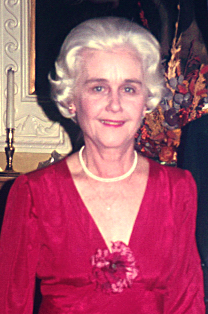
Mom sporting one of her homespun outfits. Miss you, lovely lady.

Finding the woman within, one toothpick at a time

photo 1

My mother was born in 1919, the year the dial telephone was introduced and WWI drew to a close. J. D. Salinger was a 1919-er, too, along with Eva Gabor, whom mom found silly, Nat King Cole, whose music she loved, Jackie Robinson, whom she never gave the time of day, and Balto, the renowned sled dog. She outlived them all. Against all odds, she liked her chicken fried, her pound cake with a spoonful of heavy cream, her pancakes with a thick slice of real butter, and her nightly glass of Chardonnay full to the brim. She never took a vitamin or swallowed a drop of fish oil, and unless you count a few failed games of croquet, she spent not a single minute of her adult life engaged in organized exercise.

Ok, so she had good genes. Her parents lived into their nineties, too, but I can’t help but think there was more to it than that. What was it about this lady (she was above all, a lady) that made her so resilient? Small but sturdy—5’2” with a playing weight of 106—she survived breast cancer at 81, a serious car accident at 83, the loss of her husband, a bad bout of pneumonia, and perhaps hardest of all, the death of her oldest son when she was 88. Tough as nails, her Hospice nurse called her, and a fighter, though at first glance she seemed anything but. In spite of a failing memory and the accumulation of sorrows that living long brings, she simply loved life. Even in her last difficult years, she clung to the remaining pleasures of her daily routine—a mug of coffee and a plate of eggs in the morning, a raucous visit from her great-grandchildren, an outing to Mass on Saturday evenings. Maybe this was my mother’s greatest legacy: You get up and get out of your pajamas. You engage with whatever is left to you. You hope. It served her well. She hung on as long as a body could, only breathing her last when she couldn’t swallow enough, literally, to keep her little heart beating.

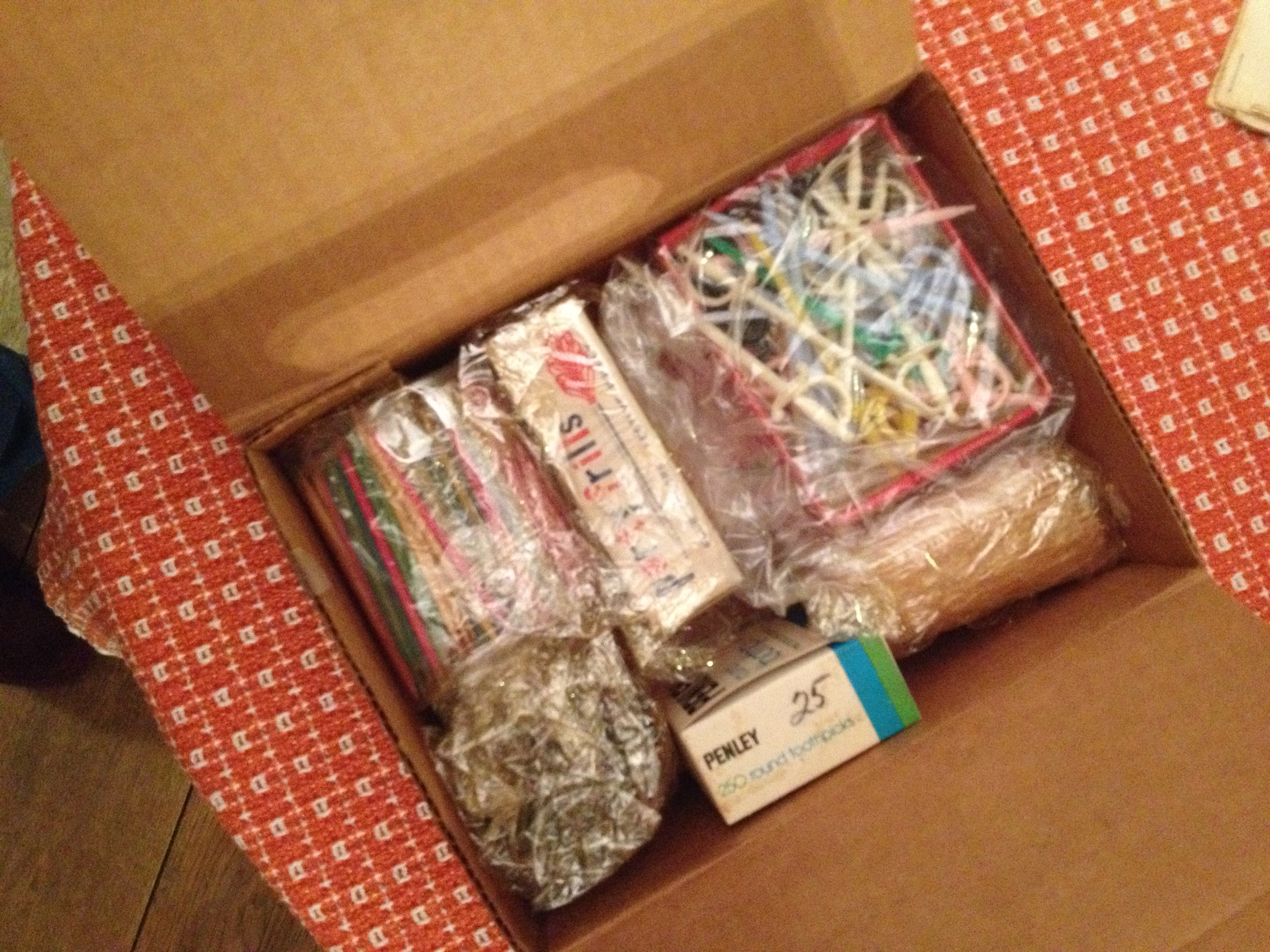
That was last October, and since she’s been gone, I’ve been sifting through what she left behind. And she left behind A LOT, ten closets and an attic filled with dust and mildew and a frightful number of rodent droppings. She hoarded, you might say, (see party toothpicks above) and it’s true that like other members of her generation, my mother spent too much time saving things from the past. Yet somehow, she was always looking to the future, too. This bothered me over the years, the way she and my father never quite got the hang of living in the moment, but maybe we in our endlessly progressive throwaway society would do well to pay attention. As I paw through hundreds of cardboard boxes gone grimy and soft with age, I’m beginning to see that these leftovers are the fruits of my mother’s particular brand of hope. After all, why save every single one of those spare buttons that come with a new blouse if you don’t imagine that one fine day, you’ll wake up and fancy wearing that blouse, and it certainly wouldn’t do to go out with your collar gaping open.

So join me. I’d love the company as I journey into the dingy corners of this moldy and mysterious place, my mother’s attic.

Generational pic, Mothers Day, 2012