Afternoons with Mary: “On my Mind and In My Spirit”

After nine long years of procrastination and skittishness, I’ve worked up the gumption to share the story of my rekindled relationship with the beloved caregiver of my youth. The story will unfold in several chapters. If you’d like to read the origins of this journey, just click here: I Am Mae Mobley


On a steamy afternoon during the troubled summer of 2016, I finally worked up the courage to call Mary Darian, the intrepid woman who half-raised me. Though I loved Mary dearly, I’d failed as an adult to stay in close touch. As each ringy-dingy sounded, I worried, whispering my introductory lines again and again. A waste of energy this. Mary knew my voice immediately—“Angel Face, is that you?” I pictured the tall, confident young woman who used to drive me to McDonald’s for a Big Mac after middle school, and let go a grateful sigh. I was no longer a school girl, of course, and Mary had long moved on from being our family’s housekeeper, but her voice still brimmed with warmth and affection.

I caught her up on family this and thats. We exchanged stories about my mother—“Now she was a real lady … ” Mary gave a chuckle. “And what a seamstress!” She’d long admired my mother’s knack with a needle, and one of her lively descriptions came to mind: Your mother made a white jacket for her new formal gown with shells around the midriff … she once penned to me at summer camp. Wow! When the lady moves, she gets momentum and never stops … I think she’s going to wear it with her sexy red sandals!

Though Mary had never much liked talking about herself, she finally told me she’d recently had a fall. “But Lou took such good care of me I’m already back on my feet!” Lou is Mary’s daughter, as loyal and kind as they come, and I noted as much. Hesitant again in light of this news (was this the time to worm my way into Mary’s life?), I took a deep breath and asked if I might drop by for a visit. “Why sure, anytime!” she said. Then a pause. “Well, anytime other than Wednesdays … I still get out for my Bible study on Wednesdays.” Smiling, I suggested the following Thursday and our plans were set.

Eighty then, Mary lived alone in the home in west Atlanta that she and her husband had moved into in the late sixties. A one-story with wood siding and four inviting windows across the front, I’d been there as a child. As I drove between sprawling azaleas lining the driveway and parked beneath the shade of a generous hardwood, I found it as cozy and comfortable as it was back then, only better. Previously a neutral cream, it had been painted a bright banana yellow. The shutters and trim, dark navy before, had gone lime green. The effect was bold and welcoming, as if the house itself wore a wry grin for neighbors and strangers alike. Perfect, I thought. Mary through and through.
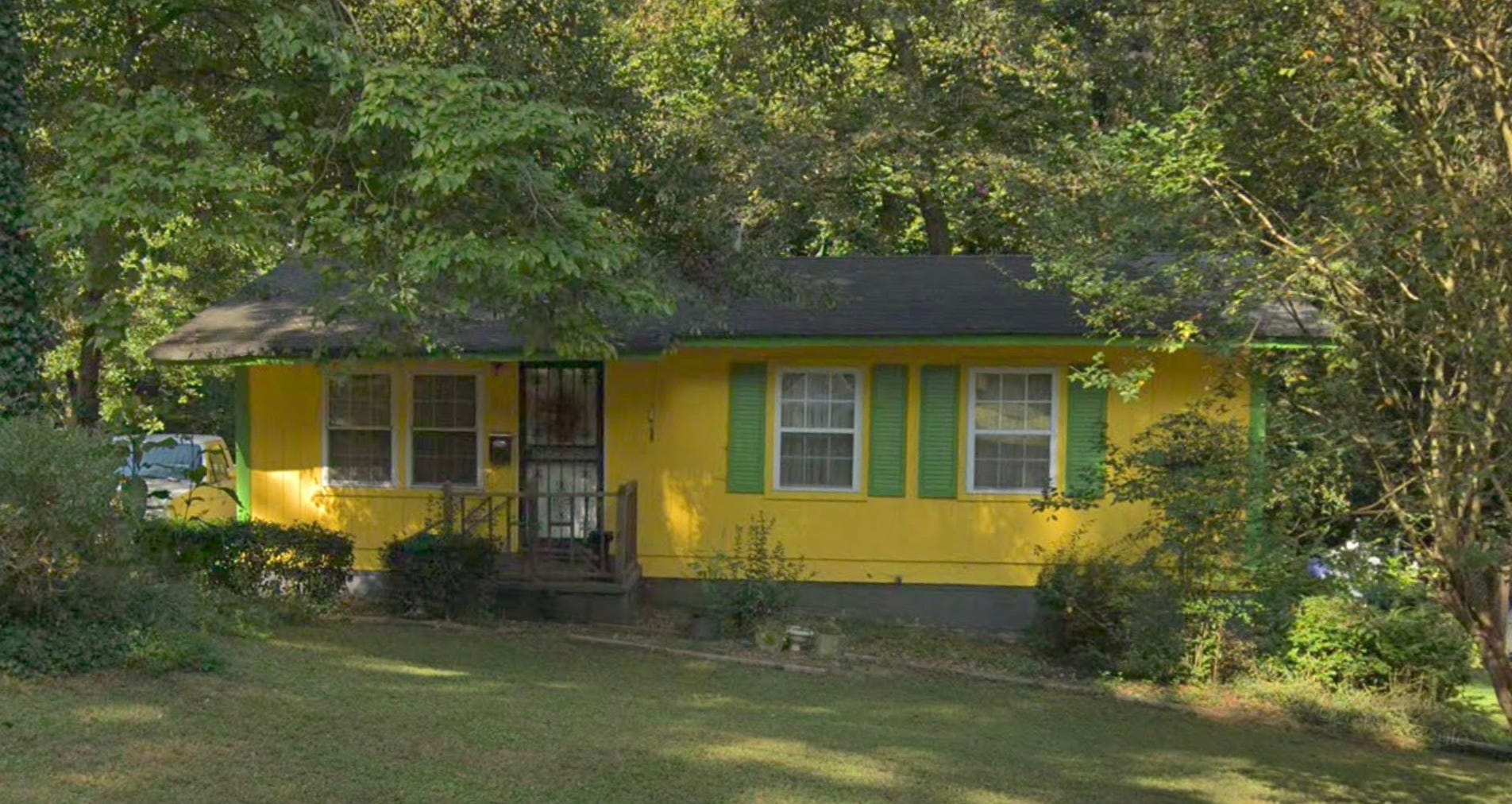
Mary’s home for over fifty years

“Come on in!” Mary said with a yelp of pleasure, and squeezed me tight. As we walked inside, she limped a little and gripped the back of a chair. I winced, reached to help, but she brushed it off. We sat side-by-side on her couch and studied the faces, many of them Mary-like, smiling out from the abundance of photos in her living room. One by one, she proudly identified family—the three sons I’d once known now become men, the late husband I never met, the many beloved grandchildren and great-grandchildren and of course, Lou, who showed up toward the end of our visit, sacks of groceries spilling from her arms as she corralled her little granddaughter through the door.

Mary had visitors most every day, family and more. She bragged on her neighbors and beaming, described the teenaged boy from her church who dropped in often to check on her. We reminisced about my parents. She asked about my children and my writing and just like that, the gap of years since we’d spent time together fell away. We joked about my older brothers’ teenaged exploits of long ago, and she said how sorry she was about the oldest, Ed, who’d been gone nine years.

“Your mama called me,” she said, her eyes damp. “More than once after he passed. Just to talk. A mother shouldn’t have to lose her child.”

“No, she shouldn’t,” I agreed, my voice wobbly. Mary took my hand and I mentioned that I’d been thinking about her a lot recently … “Especially since I rewatched The Help. Have you seen that movie?”

“Sure have,” Mary said, her tone wary.

“You know, it has its faults but it made me realize I never took the time to really get to know you … ” I began to sweat. “I guess what I’m trying to say is I’d like to learn your story, Mary. It’s something I should have done a long time ago. I’d like to know about you and your past, the way you’ve always known about me and mine.”

Her soft gaze clouded in bemusement, maybe disbelief. It wasn’t like Mary to be at a loss for words, and I looked away. Maybe I was being pushy. Maybe I should have kept my mouth good and shut.

“Well, honey,” she said finally, grinning. “It’s not all that interesting of a story, but I can probably come up with a thing or two.”

I laughed in relief, and we agreed I should return in two weeks armed with pen and paper and I-phone microphone. I wasn’t sure exactly what I would do with what she chose to share—blog? book? keep in my heart?—but I left excited about what lay ahead and hurried home to call my sister in Pennsylvania. Ten when our parents hired Mary at eighteen, JoJo loved Mary too, if in a different, maybe even deeper, way.
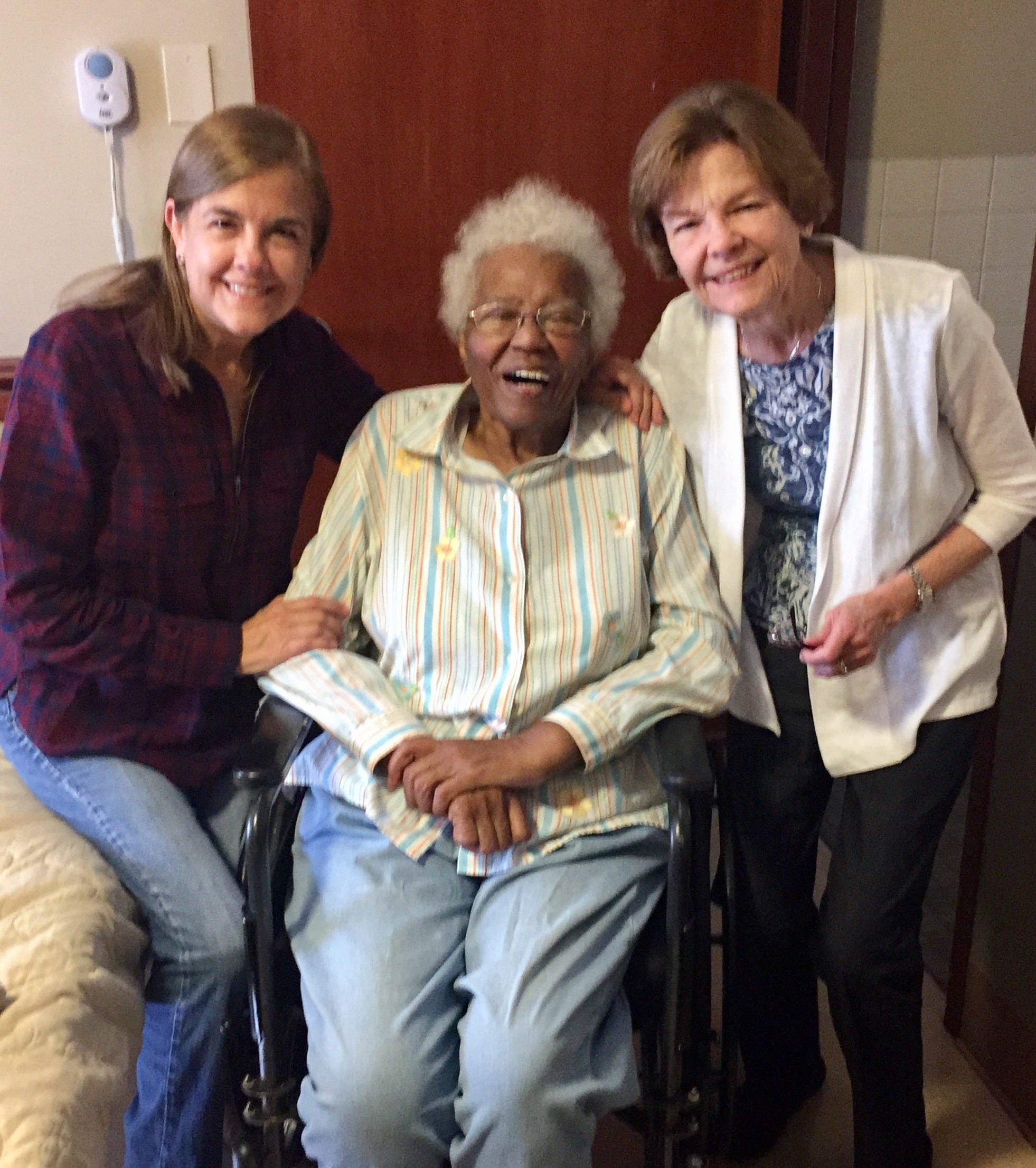
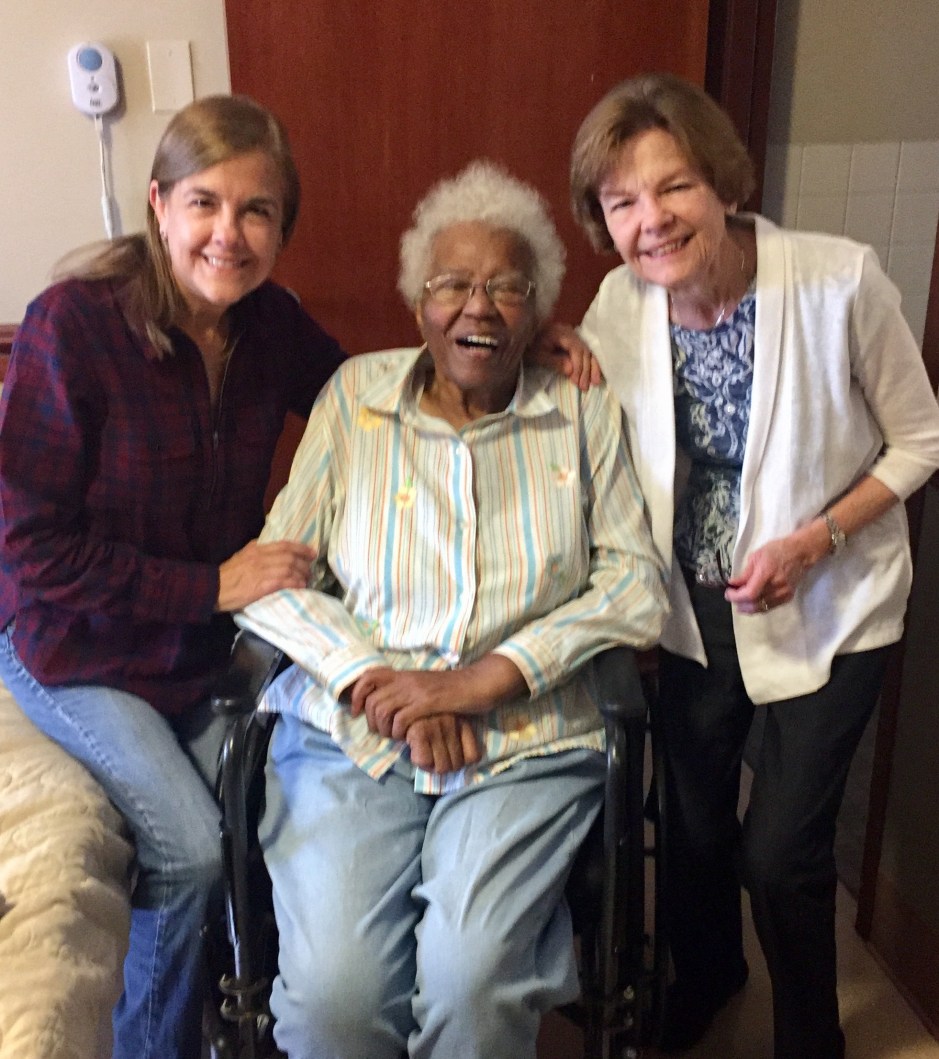
My sister and I visit Mary on her 81st birthday, November 11, 2016

A week later, Mary called, her voice subdued and full of pain, to cancel our get-together. Her oldest son, Lewis, Jr, had suddenly passed away of a heart attack, at fifty-seven. It was almost eerie, given what we’d recently said about mothers losing sons—such a cruel twist of time—and my heart ached for her. The fact that she’d lost her husband decades before in the same way and at roughly the same age only deepened her sorrow. My brother George and I attended Lewis’s funeral, a service filled with music and laughter and tears. During one of the soulful hymns, Mary, seated in a wheelchair in the front row, reached her hand toward Lewis’s casket and swayed in easy rhythm with the music. She was a woman of strong faith, among the strongest I’ve known, and I remember feeling that the air in the church seemed to shift, as if Lewis’s spirit had joined Mary’s own, and settled in to stay.

Not long after Lewis’s death, Mary had another stroke. I visited a couple of times at her rehab facility, once on her birthday when JoJo was in town, but we agreed to hold off with the note-taking and the rest until she grew stronger. The stroke had slowed Mary’s speech and in truth, I wondered if it might be best to leave well enough alone. We were back in touch, friends again, and Mary should save her energy to heal and live her best life. In the span of a few weeks, she’d given me a glimpse into her family life—who could ask for more? Tough as ever, Mary had something else up her sleeve. The next March, she reported she was much improved and ready to start getting together, only I would have to come to Lou’s house while she recuperated, which was peachy with me.

And so it began. Lou welcomed me to her home on our appointed day, and Mary, the walker she was learning to use close at hand, gestured me to join her on the couch.

“Angel Face,” she said, her trademark smile tinged with emotion. “His story has been on my mind and in my spirit.”

His story?” I asked.

“My daddy’s,” she said, touching the tight white curls around her still- smooth face. “I want to tell you my daddy’s story.”

She held up two pages of blue cursive notes written in the hand I knew from her letters, if a little uneven. I longed to hear about Mary’s life, and felt a touch disappointed.

“I’ve been trying to get it all down,” she said. “But I’m such a slow writer these days!”

“It’s hard for her …” Lou chimed in from the kitchen. “She spent days on it!”

Awed, I scanned Mary’s pages and it hit me: by sharing her father’s journey, she would be sharing her own in a manner she was comfortable with. Besides, do any of our lives make sense without the larger story of our parents and grandparents and on back?

“He was born in Hurtsboro, Alabama,” Mary began.

Hurtsboro—then a town of less than 900 residents wedged into a far southeastern lip of the state, deep in the Cotton Belt. Hurts to stay but it hurts to leave, Mary once quipped. The 1910s and 20s. The legacy of legalized slavery still shrouded the South, and Jim Crow was flexing his muscles. Mary’s father, Jimmie Lee Cochran, lived with his sister and their mother and grandmother on a white man’s farm. As early as the third or fourth grade, Mary explained, her father, “the man of the house,” often had to leave school early to go home and work the fields. Children being children, his classmates took note, in heartbreaking fashion, but a certain little girl understood Jimmie Lee’s predicament, and that would make all the difference.

Mary tells this best, so I’ll sign off for now with the brief clip above (apologies for the poor editing and annoying oohs and aaahs) in which she describes the moment her mother-to-be, Lue Milla James, first felt a pang of love for the boy who would become Mary’s father.

Home at Last

Like her father, once Mary earned the right to vote, she never missed the chance. Here she fills out her absentee ballot in October of 2018 for Georgia’s gubernatorial election.

Some of you met Mary Darian in “I Am Mae Mobley,” one of my early posts here in My Mother’s Attic. In part an outcry against an upsurge in race-related killings during the summer of 2016, that piece is at heart a tribute to Mary–the woman who helped my mother rise to the Herculean task of raising six children. Since I launched this blog, Mae Mobley continues to garner far more views than any other Attic post–testimony to Mary’s captivating character. In that earlier piece, I lamented that during the two decades Mary worked for our family, I failed to learn much about her life. I vowed then to make amends for this, to reach out to Mary, though I was more than a little nervous about cold-calling after so many years of silence. I might have known that was a waste of emotional energy. In the years that followed, in spite of facing one personal challenge after another, Mary shared detail after detail about her story, and more broadly, her family’s story, which to her were one and the same.

One morning not too long before the pandemic hit, I went to see Mary at the nursing home where she’d recently moved. Her room was small but comfortable–a sink and closet against one wall, a twin bed at the center, a broad window at the far side, the ledge below crowded with photos of her grand- and great-grandchildren. Mary’s devoted daughter, Lou, had a bird-feeder installed just outside the window so Mary could enjoy sparrows and robins and fiery red cardinals as they flitted about. By this point in her life, Mary was confined to a wheel chair, though I was soon to learn that in her case, confined did not apply.

I breezed through the door a little earlier than usual to find no Mary in sight. I heard a scuffle on the far side of the room and stepped closer. She had wheeled herself into the narrow space between bed and radiator and crouched low over her knees, her head nearly hidden between the bed and bedside table.

“Mary?” I asked, trying to control the worry in my voice. “Can I help?”

“Oh!” she said, her voice bright with enthusiasm as she looked up. “Angel Face!” (the pet name she coined for me as a baby). “Come on over here!”

I did just that. Mary craned about and reached her long arms around my neck. That’s when something shiny flashed in her lap–a long, thin metallic tool.

Celebrating Easter. April 2022

“Just give me a minute …” she said, ducking head under table again. “While I find my Puh …”

“Here, can I get it for you?” I asked, though I wasn’t sure what I was looking for. Her paper? Her pillow? I tried to maneuver between wheelchair and radiator but the space was tight, the bedside table happily cluttered–a card illustrated in blue crayon, a tub of Vaseline, a small glass vase filled with Alstroemeria, a stack of word puzzle books and a red leather Bible, its pages well-thumbed.

“What is it you need, Mary?”

No answer, just more poking at that shelf.

“Ah, here it is!” she cried at last. Turning, she sat up straight, her expression devilish and triumphant. “My Ponds!”

She held out the stick, which I then could see had a grip handle at one end and a sort of claw at the other, not unlike the mechanism in that arcade game in Toy Story (The claw is our master … ). Caught firmly in Mary’s claw was a jar of Ponds cold cream, same pale green cap and tulip logo as the ones my mother used to keep on her vanity table.

With easy dexterity, Mary twisted open the jar, scooped out a finger full, and chatting all the while, began massaging the silky cream into her still-smooth complexion. Her task complete, I offered to return the jar to its shelf. She laughed, waved me away, and did it herself, metal claw re-extended. Then she nabbed her hairbrush from the drawer, dropped it in her lap, and wheeled over to the sink. One of her feet–slightly swollen–nearly collided with the corner of the bed frame as she went.

“Mary, your leg–is it ok?”

“Oh that …” she mumbled as she set the hairbrush at the edge of the sink. “Some kind of blood clot in that old leg.” Then she plucked a cloth from a towel rod, wet it generously, and ran it across her short thick curls before brushing them out.

“Ok, now …” she went on, patting her head and smiling at my reflection in the mirror. “That’s better. I never know what it’ll look like in the mornings.” Then guttural laughter as she spun her chair around to face me. “Now tell me … What have you been up to?”

I gathered my thoughts, but before I got a word out, her eyes flew open wide and she cried, “Wait a minute! … I forgot my teeth!”

With that, and without a wrinkle of embarrassment, Mary spun back around, tugged a set of dentures out of a cup and slathered them with toothpaste. While she gave them a sturdy brushing under the faucet, I marveled at the independence, the lack of self-consciousness, and the serene acceptance of the time-consuming rituals of growing old that she possessed.

“Your mama liked Ponds, too,” she mused. “You know …” She paused and turned to me, that devilish smile restored. “She may have been the one who got me started with it!”

Whether this was true or its inverse–that Mary actually introduced my mother to Ponds–didn’t matter. This was a habit they shared, one I hadn’t known about, and something soft padded into my heart. Not a visit passed between us that Mary didn’t turn our conversations back to my parents, or one of my siblings–to those days she was part of the everyday workings of our busy household. She loved especially to wax on about my mother’s expertise as a seamstress, but then she’d been doing this since my summer camp days. Your mother made a white jacket for her new formal gown with shells around the midriff … she penned in a letter she sent off to Camp Merrie-Woode. Wow! When the lady moves, she gets momentum and never stops … Then, one of her witty after thoughts–I think she’s going to wear her sexy red sandals.

Back then, ten years old and homesick, I likely cried to read this, but it was a good cry. Mary was enfolding me from a distance into the home life I loved. I understand now that during our recent visits, she was doing much the same. Her smiles, her laughter, her stories, were keeping my mother, my father, in short, my childhood alive. She did me as much good–no, probably more–than I did her.

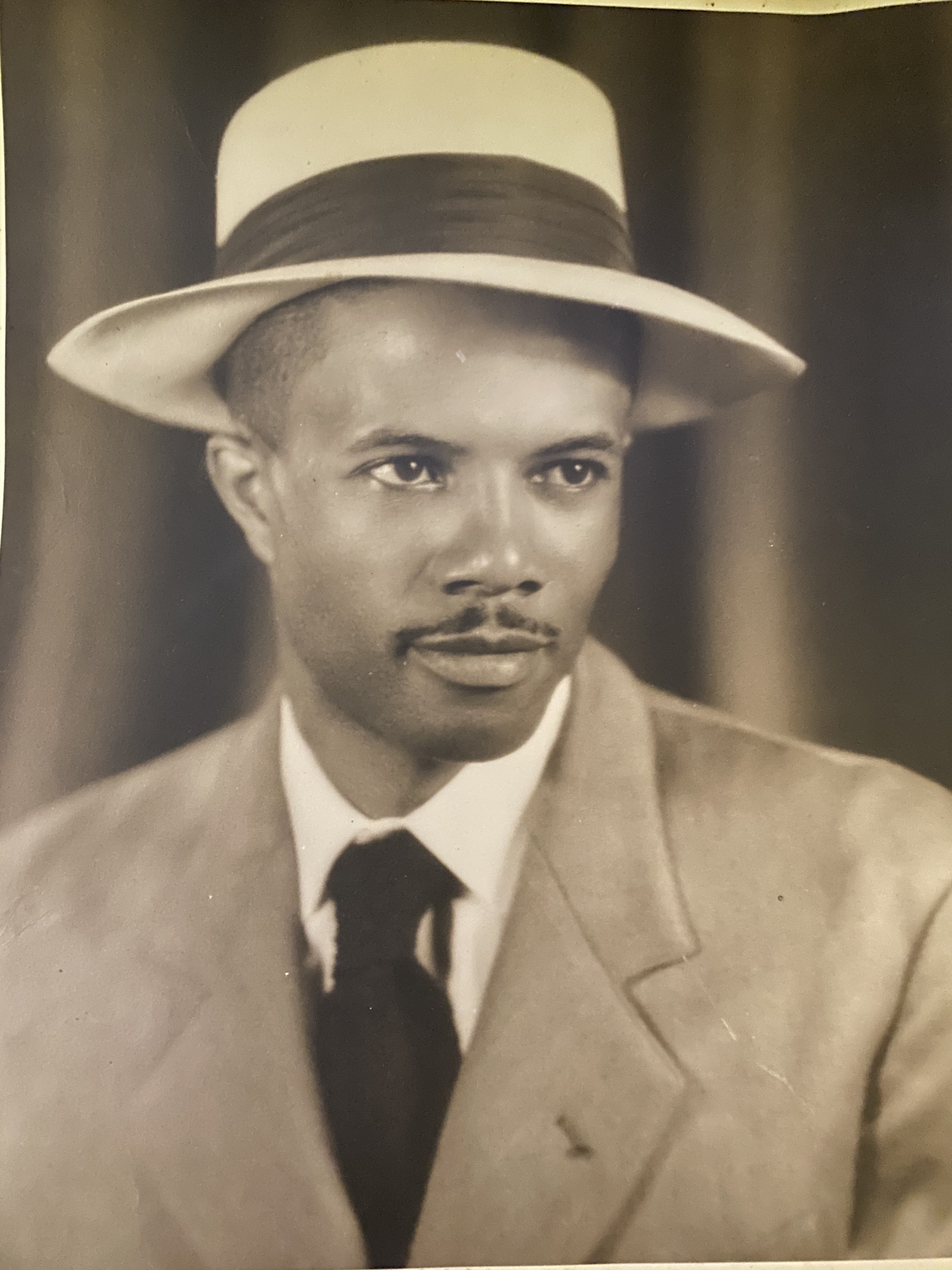
Mary’s father, Jimmie Lee Cochran, as a young man.

Though she lost her mother very young, Mary was eager to share her father’s story, too. In the 1920s, when he was hardly more than a child, Jimmie Lee Cochran worked the cotton fields of Hurtsboro, Alabama, where he lived on a farm with his mother and grandmother. In 1939, when Mary was four, Jimmie Lee came within an inch of being lynched. After a narrow escape, he managed to slip away to Atlanta, where he built a long career with Southern Railway. More importantly, a decade later Mary’s father brought her and her younger siblings to the home he’d built–literally built with his own hands–for his family. The twists and turns of Jimmie Lee Cochran’s story, and Mary’s alongside, paint a shimmering picture of courage, devotion to family, and perseverance. It’s a story that could fill a book. Maybe someday it will.

Born in 1935 in Hurtsboro, Mary Cochran Darian moved on from this world on April 18th, 2023. She worked those Alabama cotton fields herself before graduating from Atlanta’s Booker T. Washington High. She married her sweetheart, Lewis Darian, and after twenty years with our family moved on to an administrative career at Crawford Long Hospital. Through it all, Mary took care of people–her four children, her physically disabled brother, her neighbors and grandchildren, her church family (to them she was “Mother Darian”) and me and … well, the list goes on. Her family held a “Homegoing Celebration” last week at her beloved church. The service left room for sorrow but had joyful music aplenty and tributes full of love and hope meant to speed Mary along on her journey to the place she firmly believed was her true home. I think everyone who spoke of Mary mentioned that infectious smile that so warmed me during our visits in her last years. I’ve mentioned the knack Mary had for helping me laugh away my little girl challenges and preteen angst. Her ability to smile and laugh herself through the many trials of aging was to me more remarkable. My mother had her strengths, but facing old age with grace was not one of them. She raged against the dying of the light, and though there’s something to be said for that, the way Mary kept her spirits high in spite of the slings and arrows fortune tossed her way not only eased her days, it lightened the hearts of those who cared for her.

The pastor who gave Mary’s eulogy asserted that her smile set an important example. If you love God, he suggested, the least you can do is smile for the world to see. Mary’s resting face was a smile, a natural one, broad and vibrant in a way that said, Watch out because here comes a laugh, a big one straight from the belly! The photo below offers proof. I can hear my brothers and my father laughing with Mary even now.

Mary returns for a much-anticipated visit with my family, sometime in the 1980s.

The cover of Mary’s Homegoing tribute booklet features a couple of her favorite phrases. “I expect a miracle every day,” reads one of them. For those who consider miracles to be only raising the dead or turning water into wine, this may sound like hyperbole. Like the wisest among us, Mary knew that the simplest things could be miracles: The touch of her first great-great grandchild settling into her lap; the familiar taste of the meals Lou prepared at home and brought to her room; the right to vote safely and the freedom to shop where she pleased and sit at the front of the bus (freedoms she had to wait until age thirty to enjoy); the weekly Bingo games (she won a lot) with other residents in the nursing home common room; a skittish bluebird in the morning sun, darting close for a nibble from her feeder before the pushier birds moved in.

Miracles every one, just as Mary was to all who knew her. She is home now, flights of angels singing her to her rest.

Mary with her daughter, Lou Darian Qualls, on Mother’s Day, 2022

I Am Mae Mobley

My birthday is in July. Mid-summer, any way you slice it, prone to the lingering 4th hangover and hot and gluey the hemisphere around. In Atlanta, my home town, July 8th often dawns drowsy and nondescript, a day when traffic is strangely light and folks wind up sipping icy beverages by the pool or streaming baseball in front of an AC vent. I mean, think about it … has anything of true significance ever happened on July 8th? I looked it up, and–not much. In 1835, the Liberty Bell cracked, though reports vary. It might have been the 12th. In 1907, whoop-dee-doo, Ziegfield opened his first follies in New York City. 1918: Hemingway was wounded on the Austro-Italian front but macho-man that he was, survived to pen his oeuvre. 1947: a UFO crashed down in New Mexico (or not), and in 1949, Wolfgang Puck was born, followed by Kevin Bacon in ’58. Hmmm.

To be honest, I used to feel a little sorry for myself for having my special day during this time of scatter, a summer limbo void of classroom cupcakes and piñatas. When I was a wee thing, my birthday parties tended to be poorly attended at best, fleshed out with persons my mother rounded up to stand in for my wider circle of friends, who were off at camp or beach-combing with their families. Nowadays, I often vamoose on July 8th myself, and really, as the calendar turns, what could be better than to flit out of town and have one’s birthday forgotten altogether?

But in July of 2016, I was home in the city. My birth-week went haywire from the start. On Tuesday the 5th, Alton Sterling was shot by police in Baton Rouge, another possible case of color-coded fear having led to the panicked and deadly misuse of power. Ditto on the 6th, when a routine traffic stop in suburban St. Paul ended with Philando Castile, an African American man, dead. Yet sadly, if not for what happened next, on my birthday eve, these events might have become little more than tragic footnotes in the on-line version of “On This Day in History.”

As yet unaware, I woke on the 8th to the joy of family texts and emails sent at the crack of dawn and a birthday poster lovingly drawn by my youngest son. But before I could pour my first cup of Joe, I found myself longing for the dull birthday anonymity I used to lament. On the kitchen television, an endless loop of chaos and gunfire on the streets of Dallas during an otherwise peaceful protest, a dozen policemen sniper-shot, five dead.

Mass shooting number 150 or so on the year, and we were hardly halfway home. I don’t know how many of these were racially motivated, but I’d bet a silver dollar they were all rooted in hate, the kind of hate that when kindled by emotional instability is likely to fester in the heart of the dispossessed, the kind of hate that so often meets with an ironic end, where one desperate individual lashes out against others equally marginalized, but for different reasons, the kind of hate I believe is at its core self-hate, and in the end bound to turn on itself, but only after havoc has been wreaked. Consider the deeply troubled and alienated white drug addict who guns down African Americans in Charleston, in a place of worship historically vital to the Civil Rights movement; the pathologically angry Muslim American, isolated within the country of his birth, who opens fire on his gay neighbors; the mentally disturbed black war vet who ambushes white police officers as they monitor citizens of varied races seeking to prevent future incidents of policing gone sour.

Woman and Child
September, 1966, a race riot rocks the streets of Atlanta’s Summerville neighborhood. Here, a young mother clutches her young son, rescued by a white police officer from her tear-gassed home. Layer upon complex layer of anguished love.

I’m over-simplifying, and even so, my head was spinning. The line between villain and victim grows more muddied every day as hot-button issues like gun legislation, immigration, mental health care, police brutality become so multi-layered and complicated it’s impossible to discuss them without simplifying. But enough. I don’t write today to enter a particular dialogue. I write because as a white woman born and raised and still living in the American South, my bones ache with a helpless sorrow I can’t well reckon with. I write in the hope that putting words to paper will help me lasso emotions I can’t otherwise make sense of. And already I’ve erred. Sorrow isn’t the right word. What I feel is closer to despair. That we as Americans, no matter the shade of our skin, continue to wrestle with the violent manifestations of the same brand of hate, the same demons that have threatened our nation since its inception, is unthinkable.

On a long flight home that summer of 2016, I flipped through Delta’s offerings and came across The Help. I’d seen it before, and on both occasions found it more moving, more true-to-life than I expected (I boycotted the book, perhaps unfairly, having heard it was sappy and overdone). What I’d forgotten was the uncomfortable blend of warm recognition and biting shame the film dredged up in me. In some ways, I am Mae Mobley Leefolt, the little white girl loved and cared for by Aibileen Clark, the Black woman the Leefolts referred to as their maid. Mae Mobley was born, fictionally speaking, in August, 1960, in Jackson, Mississippi. I was born in July, 1960, in Atlanta. Mae Mobley had Aibileen. I had Mary Darian, the young woman who worked at our house not every day but often enough I thought of her as family. When in the final scene Mae Mobley calls out to Aibileen, “You’re my real mother!” (yep, pretty sappy), my heart leapt in spite of itself. Though my mother wasn’t negligent like Mae Mobley’s, Mary was sort of her co-mother, an energetic, funny, hands-on, more hip role model than Mom, forty-one when I came along, was capable of being.

And Mary was Black.  And far too smart, too gifted, for her position. She had small children of her own someone else cared for while she raised us, no doubt earning less than she deserved. Yet she changed my diapers and sang me to sleep. She picked me up from school and brought my dog along to greet me. She fried a chicken for us on Friday afternoons. Later, she wrote me at camp when I was homesick, sharing details about what my brothers were up to (“Tommy and I cleaned out his closet. He hates making decisions”), complimenting my mother’s sewing projects or cracking a little joke, usually at her own expense. Sometimes she signed off, tongue-in-cheek, “The Maid.” My favorite letter (from Mom’s Attic, of course) is written on two sheets of construction paper torn crookedly across the top and quadri-folded to fit the envelope. After dating the letter, Mary wrote “cheap paper” in parentheses and a few lines later elaborated: “This paper is slightly uneven–like the writer.”

image
My Crazy Maid Mary, so dubbed in an essay of the same title, one in which I sang Mary’s praises to my fourth grade teacher. I’ve searched and searched, but the Attic has yet to produce that particular heirloom. Here, she meets one of my nephews.

Mary left us when I began junior high, taking a job at the hospital where I was born. Mary made a career there, earned a few promotions and stayed on for twenty years. We kept in touch, a phone call now and then, quick visits during family weddings, funerals. Then, a long gap of time passed with little contact until the day of my mother’s funeral. As I walked out on my brother’s arm, I caught sight of Mary at the end of a pew. White-haired, a little stooped, she somehow wept and smiled at once. I stopped, and we hugged each other’s necks and cried together. She told me how much she’d loved my mother, her friend, how she misses me, and all the Mattinglys.

During the weeks after the violence of summer 2016, I thought a lot about Mary, then eighty, and felt that same warmth tempered by shame that movies like The Help can rustle up. I like to think our bond was unusual, deeper than most of its type. Mary was my friend and yet, history says what we and thousands of other Black-white, housekeeper-child duos of the fifties and sixties shared was tainted. History says that if not for the evils of slavery, these bonds wouldn’t exist, that perhaps they shouldn’t have existed. I can’t deny the truth in this, but then, what do we do with the warmth, the love, that remain?

It occurred to me that other than what I share here, I didn’t know Mary Darian’s story. I didn’t know how she, eighteen when my parents hired her, managed to break the cycle of domestic service. I knew nothing, as her white baby of the 1960s, about the sit-ins and marches, the tear-gas and beatings, that were happening across town, maybe in her neighborhood. I didn’t know who or what she might have lost to the long slog of the Civil Rights struggle. My parents, like Mary herself, were determined to shield me from these seminal, sometimes violent events that would shape our lives. In this, my ignorance of Mary’s story, lies a valid basis for guilt and shame. I can’t change history. I can’t make amends for actions taken by my forebears, though I regret and renounce them. I can’t go back and rearrange the circumstances of my relationship with Mary, but that summer I realized I could at least do what another one of Kathryn Stockett’s characters, Skeeter, does. I could learn Mary’s story. I owed her, and myself, that much.

Late that July, I dug up one of my mother’s old address books and skimmed a few pages in. There it was, between Coleman and Davis: Mary Darian. Unlike other entries, it was not written in my mother’s script. Mary had jotted in her name and address herself—of course she had—in the same big beautiful hand I’d thrilled to see in letters she wrote to homesick me at camp. Mary’s entry, unlike others, was neither scratched through nor updated. Maybe, I thought, she still lived in that tidy house I’d visited. Maybe she had the same landline my mother used to dial up whenever she missed the woman she thought of as much more than the help.

There was only one way to find out. I pushed the home button on my cell phone, and made the call.


If you’d like to read more about my journey with Mary, click here to access “Afternoons with Mary,” the sequel to this post. Many thanks for reading!